About Lenox Hill

Much of this neighborhood is occupied by "tenement" buildings because for many years an elevated rail line run up and down Third Avenue. The "El" was eventually demolished in the 1950s, which quickly led to the redevelopment of Third Avenue with high-rise luxury apartment buildings. Just to the north and south of the east side of this neigbhorhood are two luxury residential enclaves: Sutton Place at the south and the area around Carl Schurz Park at the north. In between them, New York Hospital and Rockefeller University occupy most of the neighborhood’s East River waterfront. The Art Deco tower of New York Hospital at 70th Street, designed by Coolidge, Shepley Bullfinch & Abbott, has long been a major architectural landmark.

The avenues abound with many restaurants and service retail and many high-rise, post-World War II apartment buildings. There is a cluster of movie theaters on Third Avenue across from Bloomingdale’s, the popular department store between 59th and 50th Streets that anchors the neighborhood and not far from the very colorful tram station, designed by Prentice & Chan, Ohlhausen for the ride to and from Roosevelt Island at 60th Street and Second Avenue. Unfortunately mass transit is limited to the Lexington Avenue line, but cross town buses run on 72nd, 79th and 57th Streets. Third Avenue is now this area’s most impressive avenue and host to many attractive restaurants such as the Atlantic Grill and such neighborhood retail institutions as Gracious Home, a furnishings emporium, and Grace’s Marketplace, a gourmet food store.

This neighborhood, whose sidestreets still contain many fire-escape-clad tenement buildings, most of which have been renovated, changed significantly when Sotheby’s, the auction house, decided to relocate from Madison Avenue and 76th Street to a new low-rise facility on the southeast corner of York Avenue at 72nd Street.

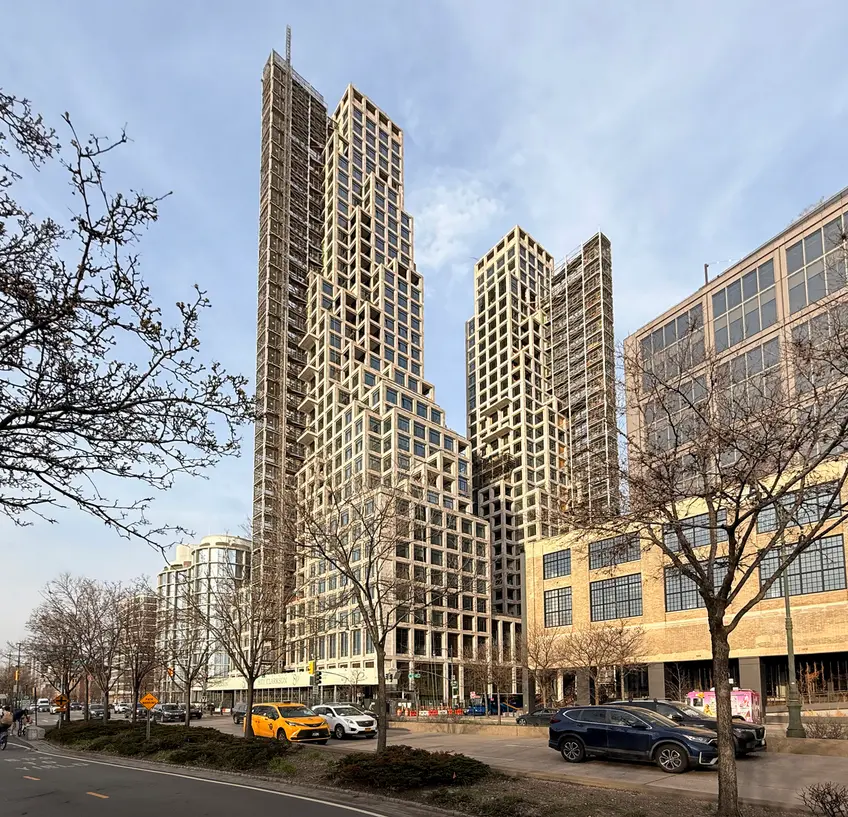
With the demolition of the very noisy "El," Third Avenue underwent significant redevelopment with many impressive "luxury" apartment towers, especially in the 60’s that dramatically altered, and raised, the area’s skyline. The tallest building on the Upper East Side is now Donald Trump’s Trump Palace on East 69th Street designed by Frank Williams. Many of the area’s most impressive new high-rise towers soon were clustered around Sotheby’s, which considered redeveloping its site with a mixed-use tower designed by architect Michael Graves but finally decided against it after several years. In 1997, the auction house opened a very attractive small restaurant and a branch of Rizzoli’s bookstore, making it an even more attractive oasis of culture. The restaurant and the bookstore, however, lasted only a few years, but Sotheby’s auction business continued.

In the early 1990’s, developer Peter Kalikow tried unsuccessfully to redevelop much of the full-block City & Suburban Homes low-rise residential complex at York Avenue and 79th Street with "luxury" apartment towers. A very vocal community group, however, won landmark designation for the tenement block and Kalikow’s plan was withdrawn. City & Suburban was an early attempt to improve housing conditions for the poor and has several courtyards, but it is not as attractive as the Cherokee apartments, a similar scheme, one block to the south.

While much of the post-World War II development of apartment houses in this area consisted of rather minimal, "white-brick" projects of little architectural distinction, the popularity of Post-Modern designs in the late 1970’s led to the construction of quite a few very handsome new apartment buildings, especially on the major cross-town streets such as 72nd and 79th Streets. The transformation of this area is far from complete, but the gentrification process is well along. Traffic on Second Avenue going to the Manhattan entrance to the Queensborough Bridge is quite heavy. One of the area’s nicest looking thin towers is Evansview (originally Memphis Uptown) at 305 East 60th Street, designed by Abraham Rothenberg and Gruzen Samton Steinglass.

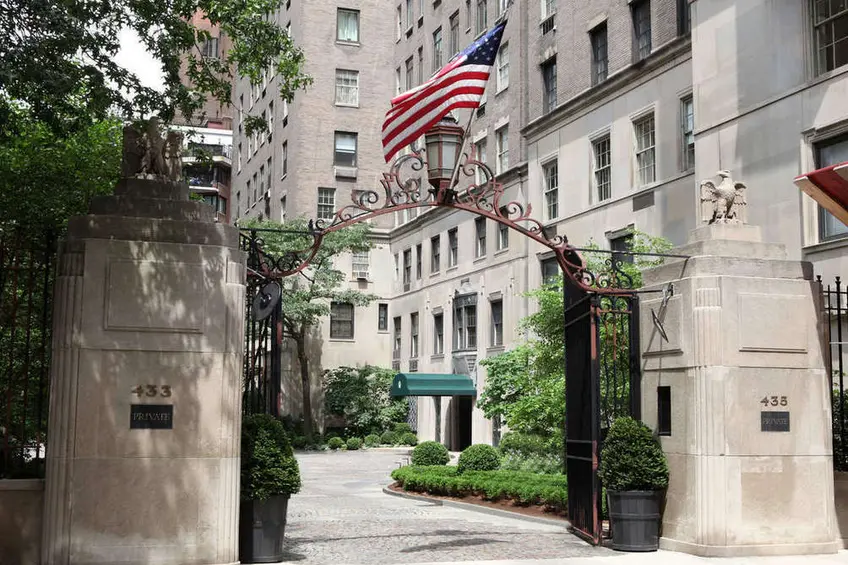
Lexington Avenue, which served as the Upper East Side’s main service retail strip, has been considerably upgraded in the 1990’s with many attractive stores and restaurants. One of the Upper East Side’s most famous restaurants for many years was Mortimer’s, which was located on the northeast corner of Lexington Avenue at 75th Street. It subsequently was replaced and nicely expanded by Orsay’s, a French restaurant. Among the area’s interesting landmarks are the Abigail Adams Smith Museum of the Colonial Dames of America at 421 East 61st Street that was built in 1799, and two black-glass residential towers developed by Sheldon H. Solow, who is best known for building the sloping glass office tower at 9 West 57th Street. One of the apartment towers has curved corners at 265 East 66th Street, and designed by Gruzen & Partners, and the other is One East River Place tucked away in a large plaza north of 72nd Street overlooking the FDR Drive.

This quadrant of the Upper East Side, unfortunately, does not have many parks, although some people consider Lenox Hill to extend to Fifth Avenue, probably because the great Frick Collection on Fifth Avenue between 70th and 71st Streets stands on the former site of the famous Lenox Library that was founded by James Lenox, who also donated land for the Union Theological Seminary and the Presbyterian Hospital, both of which were nearby but subsequently relocated uptown, and was a major benefactor of the city’s main library on Fifth Avenue and 42nd Street. The neighborhood is named after a Scottish immigrant merchant, Robert Lenox (1759-1839), who was James’s father, and who owned about 30 acres east of Fifth Avenue between 68th and 74th Streets.

The former German Hospital on the east side of Park Avenue between 77th and 76th Streets was renamed the Lenox Hill Hospital in 1918 because of anti-German sentiment during World War II.


Comments or questions? · Phone: 212.755.5544
Copyright © 1994-2012 CITY REALTY.COM INC. All Rights Reserved.
568 Broadway, Suite 802 New York, NY 10012
Terms of Use · Our Privacy Policy · About CITY REALTY.COM · Advertise With Us · Site Map
Developed by REOL Services


An equal housing opportunity.
All information furnished regarding New York City property for sale, rental or financing is from sources deemed reliable, but no warranty or representation is made as to the accuracy thereof and same is submitted subject to errors, omissions, change of price, rental or other conditions, prior sale, lease or financing or withdrawal without notice. All dimensions are approximate. For exact dimensions, you must hire your own architect or engineer.