Living in this neighborhood is like having a frontyard that is 843 acres large. That yard is known as
Central Park and its many virtues include a zoo, a carrousel, Shakespeare in the Park, tennis courts, a castle and formal gardens, bridle paths and running tracks around the "reservoir."
The majority of apartment buildings in this neighborhood were built between the turn of the century and the 1930’s. Most of them, if not all, feature
luxurious amenities such as: doormen and working fireplaces. Most of the buildings are co-ops or condos and rentals are rare and rarefied. Some of the "pre-war" buildings are fairly snooty and being a
celebrity does not open all doors all the time. There are shops on Madison Avenue but most are chic boutiques or banks.
Fifth Avenue is entirely residential in this neighborhood except for the may cultural institutions along its "Miracle Mile." Horse-drawn carriages cater to tourists at the southern end of Central Park while residents like to promenade on Madison Avenue on Saturdays, dropping into their favorite art galleries to find something for their walls or sipping Cappuccino at Sant Ambroeus, a popular Italian eatery. This is New York’s most elegant residential neighborhood.
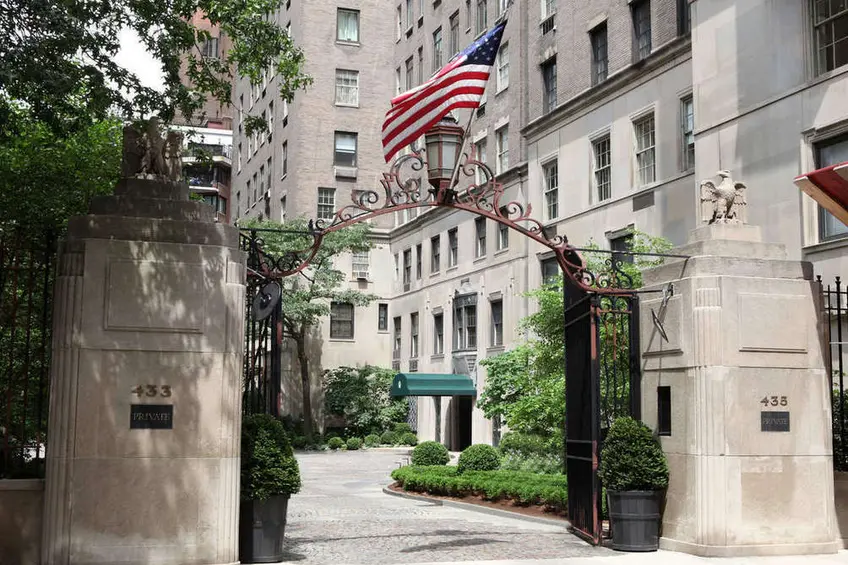
Here are many of the city’s most prestigious and expensive residential addresses like
820,
834 and
960 Fifth Avenue and
720,
740,
770 and
778 Park Avenue.
Handsome apartment buildings, however, are not the real attraction of this area, nor even Central Park.
What sets this neighborhood apart from all others is Madison Avenue. Its distinction is not architectural, although it has some fine buildings, but its ever-changing cornucopia of boutiques. Other areas may have their impressive retail strips, but Madison Avenue is the world’s most famous retail address, despite the fact that many of its grand store facades are beneath less than pristine brownstone fronts.
In addition to the boutiques and the area’s apartment houses, not all of which are distinguished, the neighborhood is noted for its very attractive sidestreets, lined with many mansions and townhouses, many of which are now owned by consulates and diplomatic missions, and art galleries.
All these contribute to the lush, and hushed, ambiance of this precinct of the privileged and powerful. This area includes the lower part of Fifth Avenue’s "Museum Mile." The only major museum on Fifth Avenue in this area, however, is
the Frick Collection at 70th Street, which many consider the crown jewel of American museums because its small collection is virtually made up only of world-class masterpieces. There are other important museums and cultural institutions nearby such as
the Whitney Museum of American Art on Madison Avenue and 75th Street and the Asia Society on Park Avenue at 70th Street.
Seventieth Street is widely considered one of the city’s most impressive streets and the block between Fifth and Madison Avenues is particularly rich in major art galleries such as Knoedler, Hirschl & Adler and Berry Hill, all among the most sumptuous and expensive in the city.
Madison Avenue’s status as a major art center was due in part to the presence for several decades of the Parke-Bernet auction house in the low-rise building on the west side of Madison Avenue between 76th and 77th Streets. As the nation’s leading auction house, it attracted many galleries to the neighborhood that had previously been located on 57th Street. The takeover of Parke-Bernet by Sotheby’s, the English auction concern, soon led to its renaming as Sotheby’s, and, unfortunately, its relocation to a warehouse-like facility on 72nd Street and York Avenue. Its former quarters have been divided into facilities for several prestigious art galleries and the former owner of the building, the late Peter Sharp, chose not to redevelop the site as it served to protect the views of Central Park from his hotel across the avenue, the Carlyle, which for decades was the tallest building on the Upper East Side and caters to a very famous clientele. The area’s fame initially came from the spectacular "Millionaire’s Mile" of mansions that lined Fifth Avenue. Most have long since been demolished to make way for apartment buildings but a hint of the lavish environment can be gleamed by the Frick Collection (that originally was the home of Henry Clay Frick, a steel magnate), the New York Institute of Fine Arts at 2 East 78th Street (that was formerly the James B. Duke Mansion, designed by Horace Trumbauer), and the Ralph Lauren store on the southeast corner of Madison Avenue and 72nd Street that was formerly the Gertrude Rhinelander Waldo mansion, designed in neo-French Renaissance style by Kimball & Thompson.
Sadly, New York City was slow to create its Landmarks Preservation Commission, which was created in 1965, and much of the great, exuberant architectural heritage of the late 19th Century and early 20th Century mansions has been lost on both Fifth and Park Avenues, although much remains on the sidestreets. Imagine if they had been preserved and most of Fifth Avenue’s apartment houses had been built on Madison Avenue or even Lexington Avenues. The city did eventually create an Upper East Side Historic District that covers most of the properties in this area between Fifth and Madison Avenues but its boundaries excluded one of Madison Avenue’s finest apartment buildings with great caryatids that was quickly torn down soon thereafter to make way for an office building developed by Leonard Stern at 667 Madison Avenue. The district’s boundaries generally extend from Fifth Avenue to between Park and Lexington Avenues except from the north side of 69th Street to 71st Street where they extend a bit beyond Lexington Avenue.
Fifth Avenue’s frontage on Central Park, of course, makes it the most desirable address, but the covering of the railroad tracks from Grand Central Terminal to 97th Street made Park Avenue a prestigious address as its width, and "park" road divider, gave it more light and air than the area’s other avenues. Park Avenue was developed with a high degree of building type uniformity that gave it considerable charm, although in the last quarter of the 20th Century its "cornice" line began to be broken with a few tall towers such as
900 Park Avenue at 79th Street.
Because Third Avenue had an "elevated" line until the mid-1950’s, the eastern portion of this area was less desirable than the western because of its considerable noise. Nevertheless, many of the blocks between Park and Third Avenue, especially in the 60’s, are extremely attractive and the redevelopment of Third Avenue with high-rise "luxury" apartment towers in the last quarter or so of the 20th Century has significantly improved the ambiance. Lexington Avenue, which serves as the area’s main service retail strip, has been considerably upgraded in the 1990’s with many attractive stores and restaurants.
The area has many of the city’s most exclusive clubs such as the Metropolitan and Knickerbocker on Fifth Avenue, the Colony and Union on Park Avenue, the Links at 36 East 62nd Street and the Cosmopolitan at 122 East 66th Street.
Transportation is quite good with southbound buses on Fifth and Lexington Avenues and northbound buses on Madison and Third Avenues. No buses are allowed on Park Avenue, while many commuter buses crowd Fifth and Madison Avenues. The area has two cross-town bus lines and subway stations are at 77th, 67th and 59th Street on Lexington Avenue and Fifth Avenue and 60th Street.
While Fifth Avenue in this neighborhood only has one religious institution, Temple Emanu-El at 65th Street, there are several on Park Avenue. The area’s main hospital is Lenox Hill, which occupies the block bounded by Park and Lexington Avenues and 76th and 77th Streets.
Among the area’s important landmarks are the fine apartment house at 45 East 66th Street, designed by Harde & Short, the 7th Regiment Armory on the east side of Park Avenue between 66th and 67th Street, designed by Charles W. Clinton with interiors by Louis Comfort Tiffany, the site of many important antiques and art shows, and the row of Georgian-style townhouses on the west side of Park Avenue between 68th and 69th Streets. The main commercial strip is centered in the southeast corner of this area, around
Bloomingdale’s at 59th Street and Lexington/Third avenues. In addition to the Carlyle, there are several hotels in this area including the Mark, the Lowell and the Plaza-Athene and some fine restaurants on some of the sidestreets.
This is probably the best neighborhood in the city for catching taxicabs. Towards the end of the 20th Century, the area began to lose a little popularity as much of the city’s nightlife "action" shifted from Yorkville and First Avenue on the Upper East Side downtown to the Flatiron District and Lower Manhattan.