163 Charles Street

FOR MORE INFORMATION ABOUT 163 Charles Street
Contact us about buying or selling an apartment in 163 Charles Street .
Email Us OR Call (212) 755-5544


163 Charles Street: CARTER'S REVIEW


The three very similar modern apartment buildings designed by Richard Meier for two different developers on West Street between Perry and Charles Streets have been widely credited with ushering in an era of "starchitect" projects that significantly upgraded the fabric of the city s new architecture in the 21st Century.

That design renaissance spread not surprisingly to the immediate neighbor of the southernmost of the Meier trio, the mid-block property at 163 Charles Street where an art dealer, Kenny Schacter commissioned a nine-story residential building from Zaha Hadid, a recent winner of the prestigious Pritzker Price for Architecture and one of the most famous female architects in the world best known for her flamboyant and fascinating architectural drawings of extreme perspectives. Mr. Schachter was married to Illona Rich, a fashioner designer who is the daughter of Denise Rich and her ex-husband, a financier who was pardoned by President Clinton.

The Schacter/Hadid scheme, however, was eventually abandoned and Mr. Schacter sold the site to Barry Leistner for about $5,900,000 and he then commissioned Daniel Goldner Architects for the project.

The Goldner design was considerably less complex than the Hadid scheme but its clean-cut modern line complemented the design of the Meier building with floor-to-ceiling windows with a Mondrianesque-pane pattern, but the project ran into opposition from the Greenwich Village Society for Historic Preservation that argued that the property and several others should be landmarked by the city.

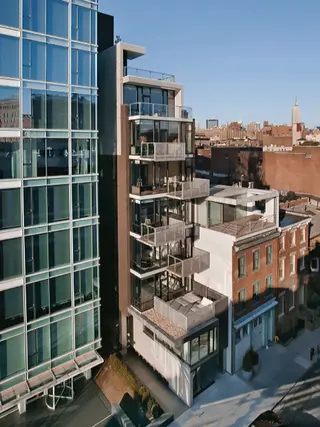
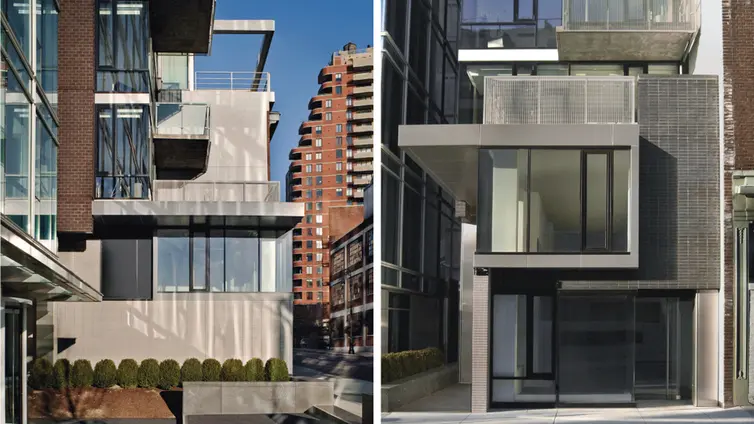
The 8-story, 22-foot-wide, Goldner design had a two-story base with a step-down entrance and four balconies with a total of two duplex apartments, ground floor commercial space and a triplex apartment.

In the press, the building was described in some articles as "Mini-Meier."

Its design in comparison with the Meier buildings is quite diminutive and demure as its tower is considerably setback above its base and its four balconies are quite deep.

The building that had been on the site was originally built for a cartman and a carpenter in 1832 and included a rear stable that had been converted to an art gallery by Vito Acconci facing Charles Lane, a narrow cobblestone street with no sidewalks.

In March, 2007, the Landmarks Preservation Commission designated as an individual landmark a nearby building at 159 Charles Street that had been erected in 1838 for Henry J. Wycoff, a merchant.

The commission noted that "it is one of the few surviving Greek Revival style rowhouses in the Hudson River waterfront section of Manhattan, specifically the area west of the Greenwich Village Historic District between West 14th Street and Lower Manhattan. Wycoff, a prominent tea and wine merchant build nine buildings on the former grounds of Newgate prison of which this is the only survivor."

"...In the early seventeenth century, the area now known as the Far West village was a Lenape encampment for fishing and planting known as Sapokanican. During Dutch rule the second director general (1633-37) of New Amsterdam, Wouter Van Twiller, 'claimed' a hugh area of land in and around Greenwich Village for his personal plantation, Bossen Bouwerie, where he cultivated tobacco. Starting in the 1640s freed African slaves, such as Anthony Portugies, Paulo d'Angolo, Simon Congo, Groot Manuel, and Manuel Trumpeter, were granted and farmed parcels of land near current-day Washington Square, Minetta Lane, and Thompson Street establishing the nucleus of a community of African-Americans that remained in this location until the Civil War."

"Under British rule during the eighteenth century, the area of Greenwich Village was the location of the small rural hamlet of Greenwich. This building is located to the west of that development in an area that part of a vast tract of land along the North (Hudson) River amassed during the 1740s by Sir Peter Warren. An admiral of the British Navy, Warren earned a fortune in prize money and had extensive land holdings throughout the New York region....Warren's three daughters, who resided in England, inherited the property after his death in 1752 and slowly sold off portions of the land. In 1788, Richard Amos, one of the Warren's trustees, acquired the position of the estate north of today's Christopher Street, between Hudson and Washington Streets. The land west of this tract was purchased in 1794 by Abijah Hammond, another of Warren's trustees and also owner of holdings to the southeast. Almost began having streets laid out in his parcel in 1796 and had subdivided the land into lots by 1817. Charles Street, said to be named for his relative, Charles Christopher Amos, was laid out by 1799."

"....Between 1796 and 1797, the first penitentiary in New York state, known as the 'State Prison at Greenwich' or Newgate State prison was constructed on a four-acre site extending between today's Christopher and Perry Street and Washington Street and the North (Hudson) River shorelines on land acquired by Abijah Hammond. Newgate's massive buildings, surrounded by high stone walls, were designed by Joseph-Francois Mangin, late the architect of City Hall (1802-11, with John McComb, Jr., and (old) St. Patrick's Cathedral (1809-15) on Mott Street."

"...the prison became a tourist attraction. Ferry service was established from the Prison's dock to Hoboken in 1799. The Greenwich Hotel, opened in 1809, near the prison; it became a popular summer resort and daily stage service was begun from the hotel to Lower Manhattan in 1811...by the early 1820s, it was obvious that the Newgate prison was a failure, subject to frequent riots and attempts to burn the buildings. Many of the Newgate prisoners were West Indian blacks who had a history of opposition to white authority. In 1824, a commission appointed to look into the problem recommending closing Newgate and erecting a new prison farther north along the Hudson River at Sing Sing (later Ossining), New York."

Mr. Leister's property has one of three developments that escaped a 2005 rezoning of the area, but his neighbor at 161 Charles Street, Jan Staller, remained unhappy at the loss of his views in his property which includes, according to a April 30, 2006 article in The York Observer by Michael Calderone, "an art installation of orange molded training pistols in the living room, a silver drive-in movie speaker (which once served as his intercom) mounted near his desk, dozens of glossy culture magazines piled on the floor and retro, snot-green medical cabinets that wouldn't look out of place in a Damien Hirst exhibition."

By November, 2009, the price of the triplex penthouse at 163 Charles Street had fallen from $16.5 million to $9.3 million while the two other apartments had been previously acquired by Solstice, a time-share club that filed for Chapt. 11 bankruptcy earlier in 2009.

The building fronts on Charles Lane, which was described by John Freeman Gill in an August 29, 2005 article in The New York Times as a "quirky one-block thoroughfare just 15 feet wide," that "contains one of the most striking juxtapositions of old nad new to be founding the evolving Far West Village."


BUILDING SUMMARY
FEATURES & AMENITIES
PROS & CONS
PROS
  • Small modern mid-block building near West Street
  • Adjacent to Richard Meier apartment building
  • Very few apartments
  • Charming narrow street
  • Large balconies
  • Close to Hudson River Park

CONS
  • Not too close to public transportation
  • No garage
  • No sidewalk landscaping

SPONSORED BY

Comments or questions? · Phone: 212.755.5544
Copyright © 1994-2012 CITY REALTY.COM INC. All Rights Reserved.
568 Broadway, Suite 802 New York, NY 10012
Terms of Use · Our Privacy Policy · About CITY REALTY.COM · Advertise With Us · Site Map
Developed by REOL Services


An equal housing opportunity.

All data is deemed reliable but is not guaranteed accurate by the REBNY / RLS or CityRealty. See Terms of Service for additional restrictions. All information furnished regarding New York City property for sale, rental or financing is from sources deemed reliable, but no warranty or representation is made as to the accuracy thereof and same is submitted subject to errors, omissions, change of price, rental or other conditions, prior sale, lease or financing or withdrawal without notice. All dimensions are approximate. For exact dimensions, you must hire your own architect or engineer. The number of bedrooms listed on this website is not a legal conclusion. Each person should consult with his/her own attorney, architect or zoning expert to make a determination as to the number of rooms in the unit that may be legally used as a bedroom.