
The Port Authority of New York and New Jersey is reported to be proposing a significant downsizing of the redevelopment of Ground Zero where terrorist attacks September 11, 2001 demolished the twin towers of the World Trade Center in Lower Manhattan.
In an exclusive article in today's edition of the New York Daily News, Douglas Feiden wrote that the authority is now proposing the redevelopment contain five rather than about 10 million square feet of office space and that two major skyscrapers planned by the site be reduced to low-rise "stumps" of four or five stories that would be used for stores.
The scaled-back plans were disclosed to The News "hours before Assembly Speaker Sheldon Silver on Friday branded budget-busting delays and cost overruns at the 16-acre site an 'embarrassment to our city, our station and our nation.'"
Janno Lieber, who is in change of the Ground Zero project for Larry Silverstein, said that Mr. Silverstein "welcomed" Mr. Silver's suggestion but did not comment on whether he would put money into the project.
An article in the May 9, edition of The New York Times by Charles V. Bagli said that "Mr. Silver called for the construction of at least three massive office towers at the world Trade Center site by 2014, despite rising vacancies and falling rents in the city's financial district." The article said that Mayor Michael R. Bloomberg immediately embraced the notion and "invited Mr. Silver, as well as the governors of New York and New Jersey, Mr. Silverstein and Port Authority officials to Gracie Mansion next week 'to find a way to align the incentives and keep progress moving at ground zero.'"
The authority's proposal would also abandon plans for "Tower 5," according to Mr. Feiden's article, that is slated to go on the Deutsche Bank building site, which was damaged in the terrorist attacks but still has not been leveled.
The Ground Zero plans received another major blow when Nicholas Ourossoff, the architecture critic of The New York Times, wrote in today's edition of the newspaper that Santiago Calatrava's plans for a transportation hub center at the site may not become "one of the few bright spots in a development plan crippled by politics, petty self-interests and the weight of the site's history."
"Even for those of us who had given up on the idea that anything good would even emerge from ground zero," Mr. Ouroussoff wrote, "the unveiling of an elaborate new model of the revised design on Saturday at the Queen Sofia Spanish Institute was heart wrenching." Mr. Ouroussoff argued that the hub "remains unable to overcome the project's fatal flaw: the striking incongruity between the extravagance of the architecture and the limited purpose it services."
"Mr. Calatrava," according to Mr. Ouroussoff, "created a vast central hall...50 feet below ground and underneath a soaring elliptical glass-and-steel dome. The dome was supported by a system of curved white beams that suggested the rib cage of a gigantic prehistoric bird....Mr. Calatrava's mechanical roof would open...with its wings moving up and down....The reason for the hall's enormous scale was further put into question when state and city officials dropped the idea of creating a link to La Guardia and Kennedy airports. Though Mr. Calatrava's hall was 14,000 square feet bigger than Grand Central's, it would now serve only a small fraction of the passengers....The model at the Spanish Institute shows a new version of the roof structure, which will have fixed wings to cut down on costs....And in a particularly perverse decision PATH riders won't be able to get from the train platforms directly to the street. Instead they will have to walk halfway along the hall's upper balconies and past dozens of shops before exiting into one of the flanking towers....it should surprise no one that what once promised to be one of ground zero's most triumphant architectural achievements is hollow at its core."
In an exclusive article in today's edition of the New York Daily News, Douglas Feiden wrote that the authority is now proposing the redevelopment contain five rather than about 10 million square feet of office space and that two major skyscrapers planned by the site be reduced to low-rise "stumps" of four or five stories that would be used for stores.
The scaled-back plans were disclosed to The News "hours before Assembly Speaker Sheldon Silver on Friday branded budget-busting delays and cost overruns at the 16-acre site an 'embarrassment to our city, our station and our nation.'"
Janno Lieber, who is in change of the Ground Zero project for Larry Silverstein, said that Mr. Silverstein "welcomed" Mr. Silver's suggestion but did not comment on whether he would put money into the project.
An article in the May 9, edition of The New York Times by Charles V. Bagli said that "Mr. Silver called for the construction of at least three massive office towers at the world Trade Center site by 2014, despite rising vacancies and falling rents in the city's financial district." The article said that Mayor Michael R. Bloomberg immediately embraced the notion and "invited Mr. Silver, as well as the governors of New York and New Jersey, Mr. Silverstein and Port Authority officials to Gracie Mansion next week 'to find a way to align the incentives and keep progress moving at ground zero.'"
The authority's proposal would also abandon plans for "Tower 5," according to Mr. Feiden's article, that is slated to go on the Deutsche Bank building site, which was damaged in the terrorist attacks but still has not been leveled.
The Ground Zero plans received another major blow when Nicholas Ourossoff, the architecture critic of The New York Times, wrote in today's edition of the newspaper that Santiago Calatrava's plans for a transportation hub center at the site may not become "one of the few bright spots in a development plan crippled by politics, petty self-interests and the weight of the site's history."
"Even for those of us who had given up on the idea that anything good would even emerge from ground zero," Mr. Ouroussoff wrote, "the unveiling of an elaborate new model of the revised design on Saturday at the Queen Sofia Spanish Institute was heart wrenching." Mr. Ouroussoff argued that the hub "remains unable to overcome the project's fatal flaw: the striking incongruity between the extravagance of the architecture and the limited purpose it services."
"Mr. Calatrava," according to Mr. Ouroussoff, "created a vast central hall...50 feet below ground and underneath a soaring elliptical glass-and-steel dome. The dome was supported by a system of curved white beams that suggested the rib cage of a gigantic prehistoric bird....Mr. Calatrava's mechanical roof would open...with its wings moving up and down....The reason for the hall's enormous scale was further put into question when state and city officials dropped the idea of creating a link to La Guardia and Kennedy airports. Though Mr. Calatrava's hall was 14,000 square feet bigger than Grand Central's, it would now serve only a small fraction of the passengers....The model at the Spanish Institute shows a new version of the roof structure, which will have fixed wings to cut down on costs....And in a particularly perverse decision PATH riders won't be able to get from the train platforms directly to the street. Instead they will have to walk halfway along the hall's upper balconies and past dozens of shops before exiting into one of the flanking towers....it should surprise no one that what once promised to be one of ground zero's most triumphant architectural achievements is hollow at its core."
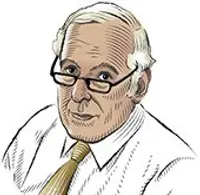
Architecture Critic
Carter Horsley
Since 1997, Carter B. Horsley has been the editorial director of CityRealty. He began his journalistic career at The New York Times in 1961 where he spent 26 years as a reporter specializing in real estate & architectural news. In 1987, he became the architecture critic and real estate editor of The New York Post.

 6sqft delivers the latest on real estate, architecture, and design, straight from New York City.
