
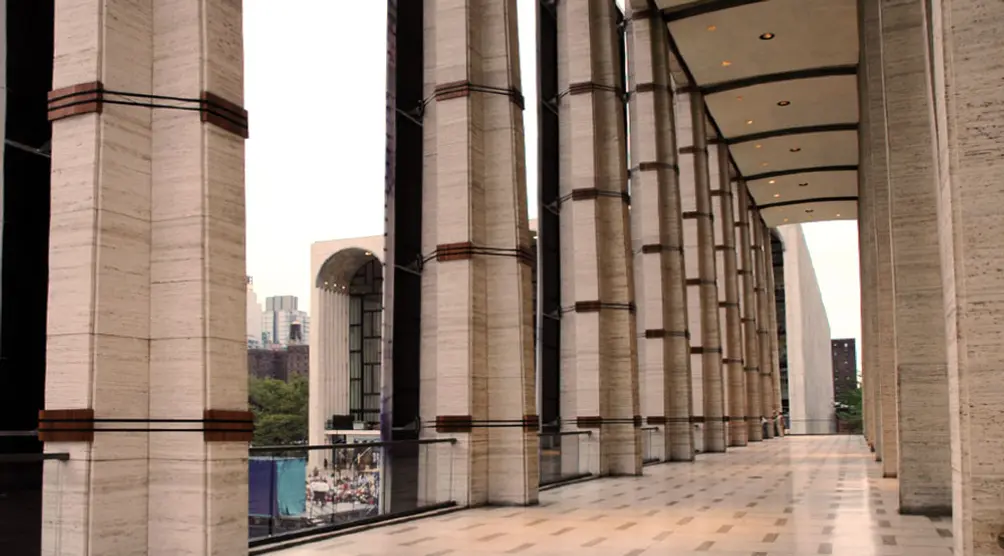
 An arcade at Lincoln Plaza
Manhattan does boast some of these architectural gems, and perhaps their most ardent lovers are the smokers at office buildings, who have been forced outdoors in recent years and seek shelter under them.
Building arcades, famous in Paris, where they line the bases of most buildings along the Rue de Rivoli, are rare in New York. While the city has flirted with plaza designs in an effort to expand open spaces in dense neighborhoods, it has not focused on arcades, though they are ideal for providing widened pedestrian areas.
Still, Manhattan does boast some of these architectural gems, and perhaps their most ardent lovers are the smokers at office buildings, who have been forced outdoors in recent years and seek shelter under them.
One of the city's first major arcades was created at the Barclay-Vesey Building at 140 West Street, designed by Ralph Walker of McKenzie, Voorhees & Gmelin in 1927. Taking advantage of building incentives that were part of the 1969 Lincoln Square special zoning district, Seymour Milstein built arcades at One Lincoln Plaza at 20 West 64th Street. and at 30 Lincoln Plaza, one block to the south. The arcades, designed by Philip Birnbaum in 1971 and 1979, respectively, are successful because they are high enough to avoid being claustrophobic and wide enough to permit some sidewalk cafes. Undoubtedly, the city's most famous arcades are at the Lincoln Center for the Performing Arts. The New York State Theater, designed by Philip Johnson and Richard Foster in 1964, and Avery Fisher Hall, designed by Harrison & Abramovitz in 1962, have the most handsome arcades in the city.
One of the Manhattan's sprightliest arcades can be found at 777 Third Avenue, an office building designed by William Lescaze and erected in 1963 by the William Kaufman Organization. The arcade is highlighted by a large, red swing seat in the shape of a piano lid that was designed by Theodore Ceraldi and is suspended under the arcade.
The Kaufman Organization also created the handsome curved arcade at 17 State St., which pairs well with the reflective-glass curtain wall, designed by Richard Roth Jr. in 1989. Another curved arcade can be found at the so-called Lipstick Building at 885 Third Ave., designed in 1986 by Philip Johnson and John Burgee. And a third arcade with angled columns is at 9 West 57th Street, designed by Skidmore, Owings & Merrill in 1974.
Still, Manhattan does boast some of these architectural gems, and perhaps their most ardent lovers are the smokers at office buildings, who have been forced outdoors in recent years and seek shelter under them.
One of the city's first major arcades was created at the Barclay-Vesey Building at 140 West Street, designed by Ralph Walker of McKenzie, Voorhees & Gmelin in 1927. Taking advantage of building incentives that were part of the 1969 Lincoln Square special zoning district, Seymour Milstein built arcades at One Lincoln Plaza at 20 West 64th Street. and at 30 Lincoln Plaza, one block to the south. The arcades, designed by Philip Birnbaum in 1971 and 1979, respectively, are successful because they are high enough to avoid being claustrophobic and wide enough to permit some sidewalk cafes. Undoubtedly, the city's most famous arcades are at the Lincoln Center for the Performing Arts. The New York State Theater, designed by Philip Johnson and Richard Foster in 1964, and Avery Fisher Hall, designed by Harrison & Abramovitz in 1962, have the most handsome arcades in the city.
One of the Manhattan's sprightliest arcades can be found at 777 Third Avenue, an office building designed by William Lescaze and erected in 1963 by the William Kaufman Organization. The arcade is highlighted by a large, red swing seat in the shape of a piano lid that was designed by Theodore Ceraldi and is suspended under the arcade.
The Kaufman Organization also created the handsome curved arcade at 17 State St., which pairs well with the reflective-glass curtain wall, designed by Richard Roth Jr. in 1989. Another curved arcade can be found at the so-called Lipstick Building at 885 Third Ave., designed in 1986 by Philip Johnson and John Burgee. And a third arcade with angled columns is at 9 West 57th Street, designed by Skidmore, Owings & Merrill in 1974.
Related Articles
Future New York
Lee Radziwill’s former Fifth Avenue duplex among Manhattan sales; Alphabet City two-bed sells for 227% profit
Wednesday, May 27, 2026
Future New York
Where buildings meet the sky: The return of the cornice, from Fifth Avenue to Lispenard Street
Wednesday, April 15, 2026
Future New York
Top 10 condos in Turtle Bay and Beekman-Sutton Place + New developments and price-reduced listings
Thursday, June 11, 2026
Great Listings
Where would the Knicks live? See the ultimate NYC apartments for watch parties
Thursday, June 11, 2026
Future New York
Price Cuts: Former Kips Bay Decorator Showhouse down by $9.5M; Karim Rashid to take loss on Hell's Kitchen condo
Thursday, June 11, 2026
Future New York
Over $600M in Manhattan contracts include FiDi penthouse with indoor slide and Mish Fine Jewelry founder’s Village co-op
Wednesday, June 10, 2026
Riverside Dr./West End Ave.
Three Waterline Square launches lottery for UWS apartments priced from $782/month
Wednesday, June 10, 2026
Future New York
Above the Crowd: NYC apartments with skyline views as observation deck boom reaches new heights
Wednesday, June 10, 2026
Architecture Critic
Carter Horsley
Since 1997, Carter B. Horsley has been the editorial director of CityRealty. He began his journalistic career at The New York Times in 1961 where he spent 26 years as a reporter specializing in real estate & architectural news. In 1987, he became the architecture critic and real estate editor of The New York Post.

 6sqft delivers the latest on real estate, architecture, and design, straight from New York City.
