

For decades, New York City has been a place where young adults from around the world come to start careers, pursue creative pursuits, and, in some cases, start families. While young people continue to flock to New York City, a growing percentage now leave before or shortly after having children. Could Mayor Mamdani’s proposal for free child care reverse this trend?
Why young families are leaving New York City
While finding a high-quality school in New York City can be challenging, even within the public system, there are plenty of great options. As a result, rather than cite school choice or safety concerns, young families who leave New York City for the suburbs or other cities nearly always cite the high cost of living. In the current economy, a growing number of New Yorkers, including dual-income professional couples, are impacted by the city’s high cost of living. In fact, by some accounts, a majority of New Yorkers (62 percent) no longer meet the True Cost of Living (TCOL) threshold.
While everything in New York City, from food to entertainment, often seems to cost more than in other cities, for young families, two costs appear particularly challenging—childcare and housing.
What is the TCOL for families in New York City?
Assessing the TCOL for families in New York City isn’t easy, since different families have different expectations, and some are naturally more willing to make extraordinary sacrifices to stay in the city. Still, however you slice it, New York City is among the most expensive places in the world to raise a family.
A March 2026 report published by the NYC Mayor's Office of Equity & Racial Justice found that adding a child to one’s household more than doubles one’s expenses. According to the report (which is notably based on 2022 data), on average, a single adult without children requires $70,334 annually to meet the TCOL threshold in New York City, while a family of four (two adults, two children) requires $166,279, more than double the amount needed for a single person to meet the city’s TCOL. While food, transportation, and health costs all increase when one adds children, childcare costs and housing are especially high.
The NYC Mayor’s Office of Equity and Racial Justice study found that annual childcare costs (for children under 13 or, if they have a disability, for those between 13 and 18) are $13,416. However, some studies suggest pre-K childcare costs are much higher. A 2024 study published by Columbia University’s Institute for Global Politics reports that from 2019 to 2024, “the average annual cost of childcare for infants and toddlers in New York City rose sharply,” with family-based care increasing by 79 percent to an average of $18,200 and center-based care increasing by 43 percent to $26,000.
According to the NYC Mayor’s Office of Equity and Racial Justice study, having children also raises housing costs by roughly $5,000 annually, but this figure may also be a gross underestimation of the TCOL for families, especially once one considers 2026 housing costs. As of May 2026, Corcoran reported that the average rent by bedroom was $8,056 for a two-bedroom and $12,999 for a three-bedroom in Manhattan. At $5,831 for a two-bedroom and $7,741 for a three-bedroom, Brooklyn rates were still lower on average, but by no means highly affordable, even for most middle-class families.
If one takes these current statistics on the average cost of housing into account, there is no question that the median cost of housing annually for a family in New York City is not $26,704, as suggested in the NYC Mayor’s Office of Equity and Racial Justice study, but much higher. In most Brooklyn and Manhattan neighborhoods, it is likely now between $65,000 and $100,000 for a two-bedroom, and over $150,000 on average for a three-bedroom in Manhattan.
So, how much money does one need to raise children in New York City? In the current market, even if you opt to send your children to public schools, it seems reasonable to conclude that, to comfortably cover basic costs, you now need to earn more than $200,000 annually as a family (even more if you have pre-school-age children). Given the local tax rate, this likely means having an adjusted gross income of at least $300,000.
Is child care enough to make family life affordable?
In spring 2026, Governor Hochul, in partnership with Mayor Mamdani, announced plans to expand free child care for all children ages 3 and up, while also investing in the mayor’s plans to support universal child care for children as young as 2 years old.
As a result, going into the 2026-2027 school year, families in New York City will not only have access to free childcare and schooling for children ages 3 and up, but also a limited number of spots will be available for children as young as 2 years old. The first four communities to receive free childcare for 2-year-olds, regardless of their income, zip code, or immigration status, will be in the following neighborhoods:
- School District 6: Washington Heights, Inwood and Hamilton Heights as well as parts of Manhattanville
- School District 10: Fordham, Belmont, Norwood, Marble Hill, Morris Heights, Riverdale, Spuyten Duyvil, Van Cortlandt Village and Kingsbridge as well as parts of Kingsbridge Heights, Bedford Park, Mount Hope, Claremont- Bathgate & East Tremont
- School Districts 18 and 23: Canarsie, Rugby-Remsen Village, Brownsville and Ocean Hill as well as parts of East Flatbush- Farragut and Prospect Lefferts Garden-Wingate
- School District 27: Ozone Park, South Ozone Park, Richmond Hill, Woodhaven, Howard Beach and Rockaways as well as parts of Lindenwood and Springfield Gardens North
While free daycare, even for very young children, is a step in the right direction, it will only address one of the many costs of raising children. Other costs, including the longer-term costs of housing, healthcare, food, and transportation, remain untouched. However, several buildings in desirable neighborhoods have affordable housing components, and new ones are in the works.
Housing lotteries and affordable buildings
343 Himrod Street, Bushwick
Developed by LC Management
Design by ND Architecture and Design
8 stories | 75 units
Two-beds from $1,238 - $2,331
Lottery deadline: July 20, 2026
Developed by LC Management
Design by ND Architecture and Design
8 stories | 75 units
Two-beds from $1,238 - $2,331
Lottery deadline: July 20, 2026
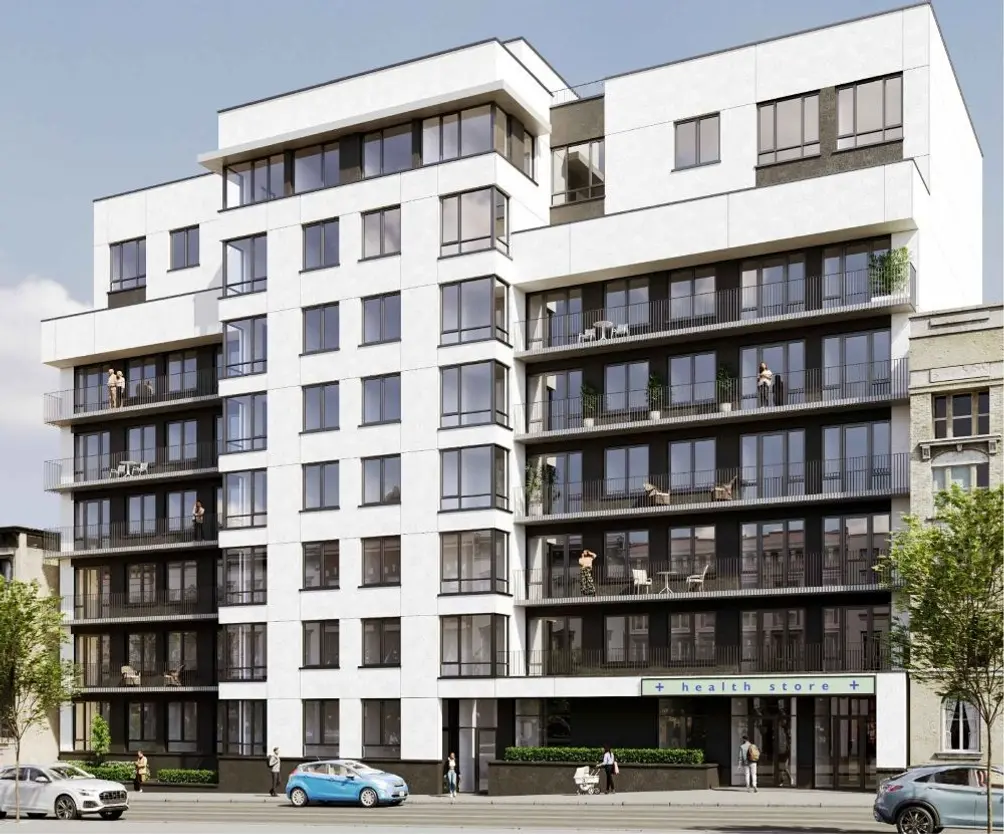 343 Himrod Street (Housing Connect)
In the heart of Bushwick, a gleaming new rental at 343 Himrod Street stands out for its striking white facade with oversized windows. Several apartments have private balconies, and all interiors feature modern finishes, spacious layouts, hardwood floors, energy-efficient appliances including dishwashers and washer/dryers, and central heating and air conditioning.
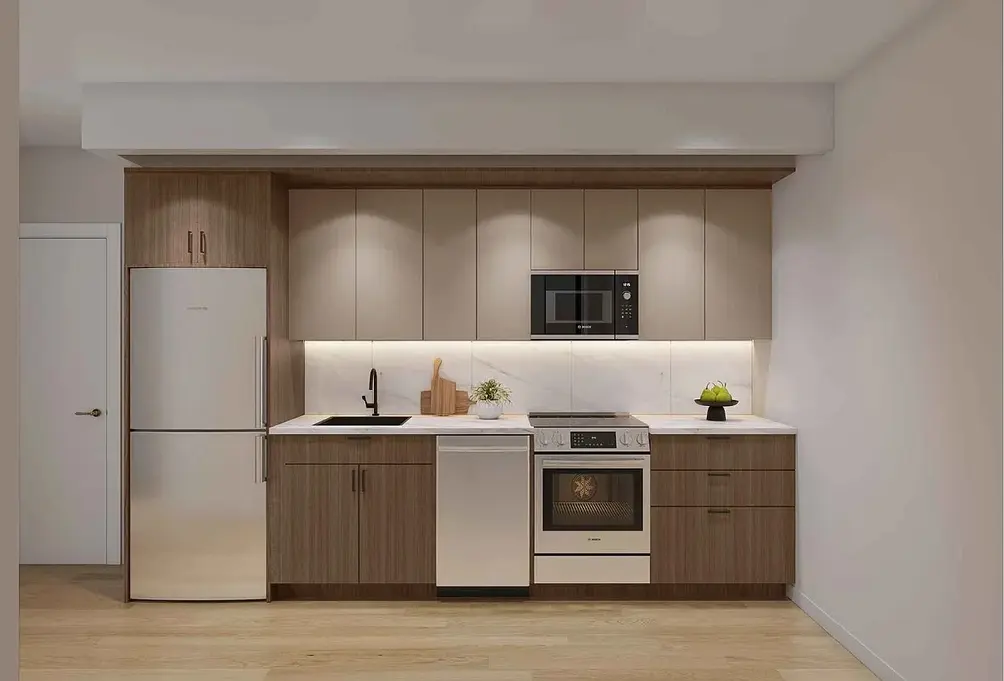
Residents arrive to an attended lobby, and amenities include a fitness center, a coworking lounge with private work stations, a lounge with pool table, and a landscaped roof terrace with city views. The building welcomes pets and has a dog run; further conveniences include package lockers, a central laundry room, and bike storage. It is located a short distance from the Dekalb Avenue L and Knickerbocker Avenue M trains, but there is much to offer close to home with several independent restaurants and retailers.

Columbia Commons I, Red Hook
498 Columbia Street
Developed by Express Buildings and The Jericho Project
Design by Aufgang Architects
8 stories | 371 units
Studios to two-beds from $777 - $2,668
Lottery deadline: August 28, 2026
498 Columbia Street
Developed by Express Buildings and The Jericho Project
Design by Aufgang Architects
8 stories | 371 units
Studios to two-beds from $777 - $2,668
Lottery deadline: August 28, 2026
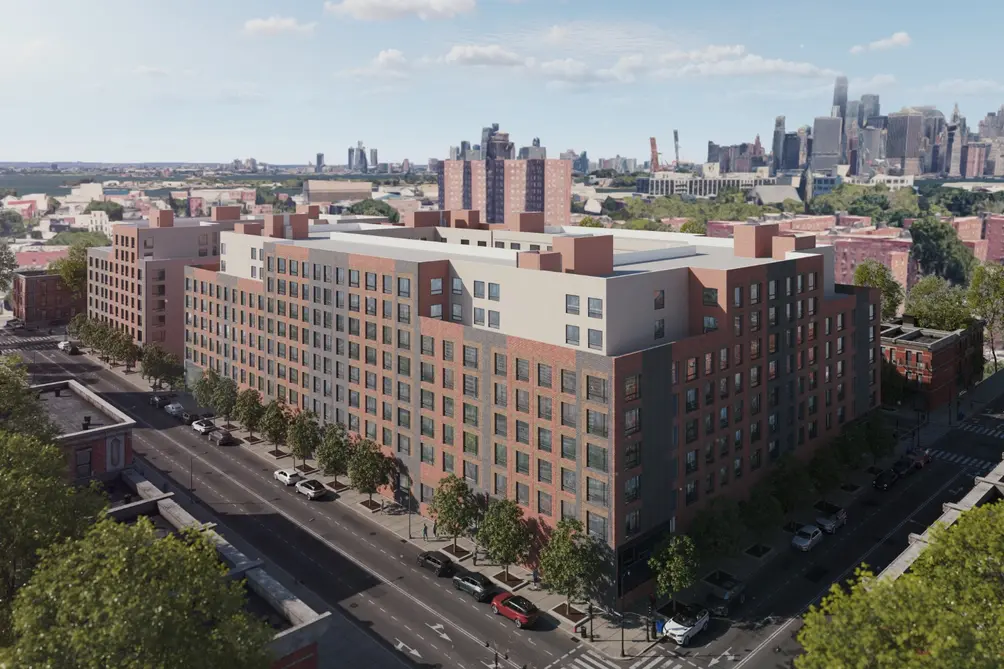 Columbia Commons I (Housing Connect)
According to New York Real Estate Journal, the Columbia Commons complex is the first large-scale residential development in Red Hook. Construction is being done in phases, and an affordable housing lottery is underway for the first and largest phase. Apartments are affordable to households earning 40, 60, and 100 percent of the Area Median Income.
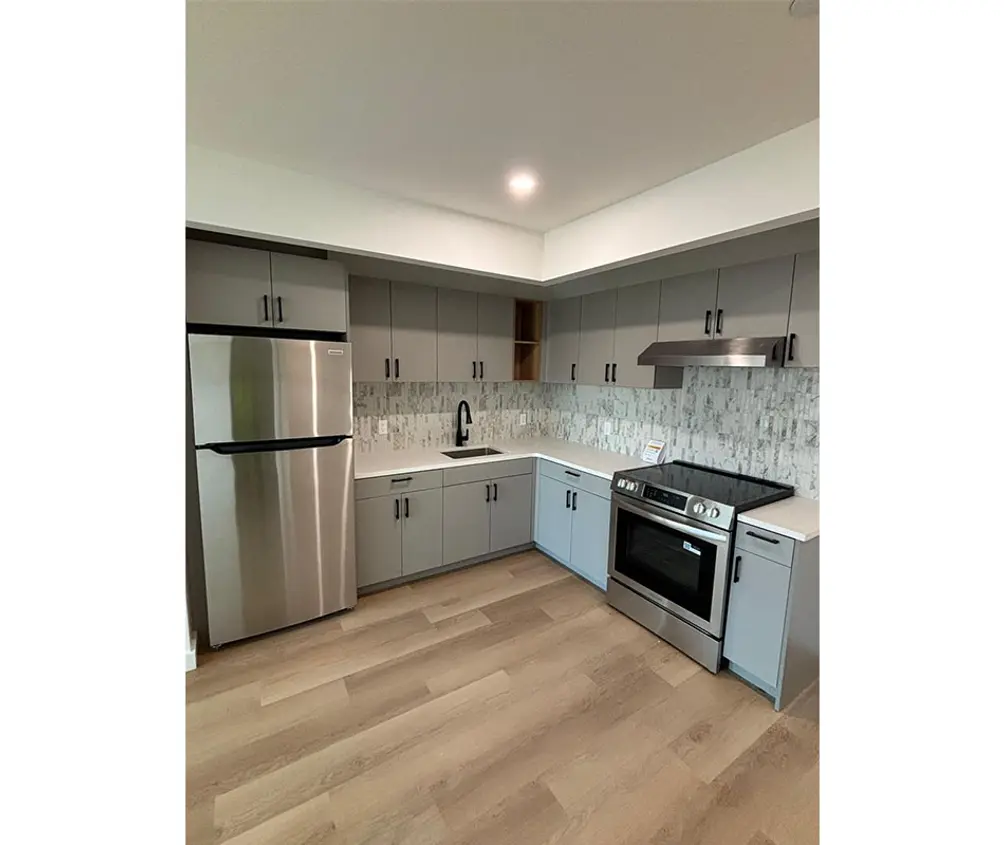
Columbia Commons will deliver 100 percent affordable and supportive housing units, with services provided by Jericho Project. All apartments feature oversized windows and energy-efficient appliances, not to mention come equipped with high-speed internet. A security guard is on staff, and amenities include bike storage, a shared laundry room, indoor community rooms, and common outdoor space. 6sqft points out that while there isn't a subway station in the neighborhood, Columbia Commons is located in close proximity to the NYC Ferry terminal, not to mention IKEA for easy furnishing of new homes.
Jamaica Central
89-25 162nd Street
Developed by Vaja Group
Design by S. Wieder Architect
14 stories | 89 units
Three-beds from $1,323 - $2,586
Lottery deadline: August 3, 2026
89-25 162nd Street
Developed by Vaja Group
Design by S. Wieder Architect
14 stories | 89 units
Three-beds from $1,323 - $2,586
Lottery deadline: August 3, 2026
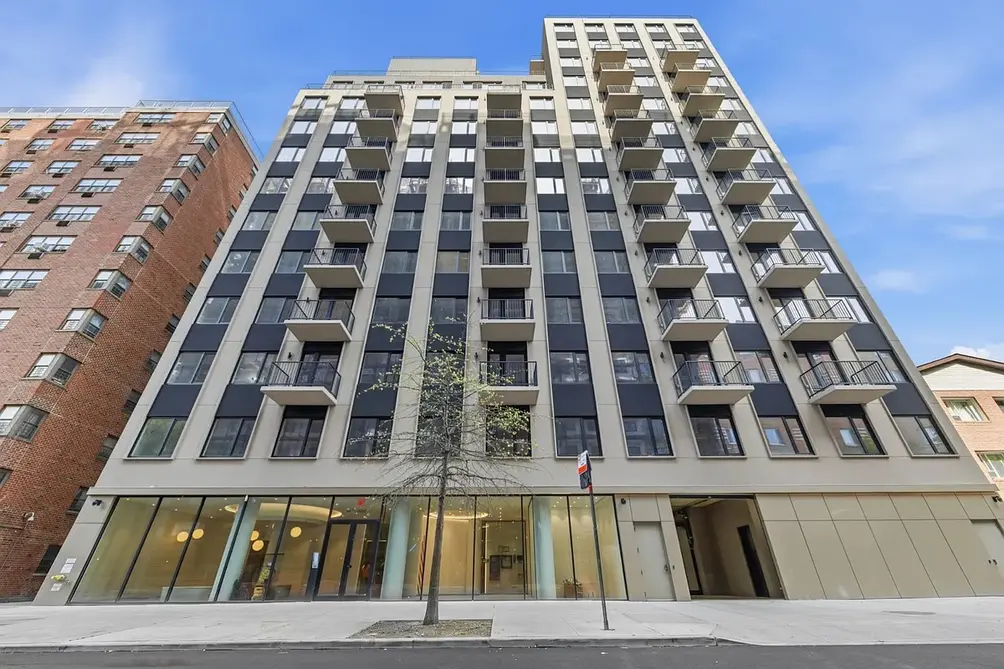 Jamaica Central (Living New York)
Jamaica Central is a new high-rise in the heart of Queens, and a housing lottery currently in effect would appear to have been conceived with families in mind: Households of three to seven people, earning 40 to 70 percent of the Area Median Income, are eligible to apply for affordable three-bedroom apartments. All apartments have private balconies, and interiors feature condo-caliber finishes, white oak flooring, kitchens with polished white countertops, and in-unit laundry.
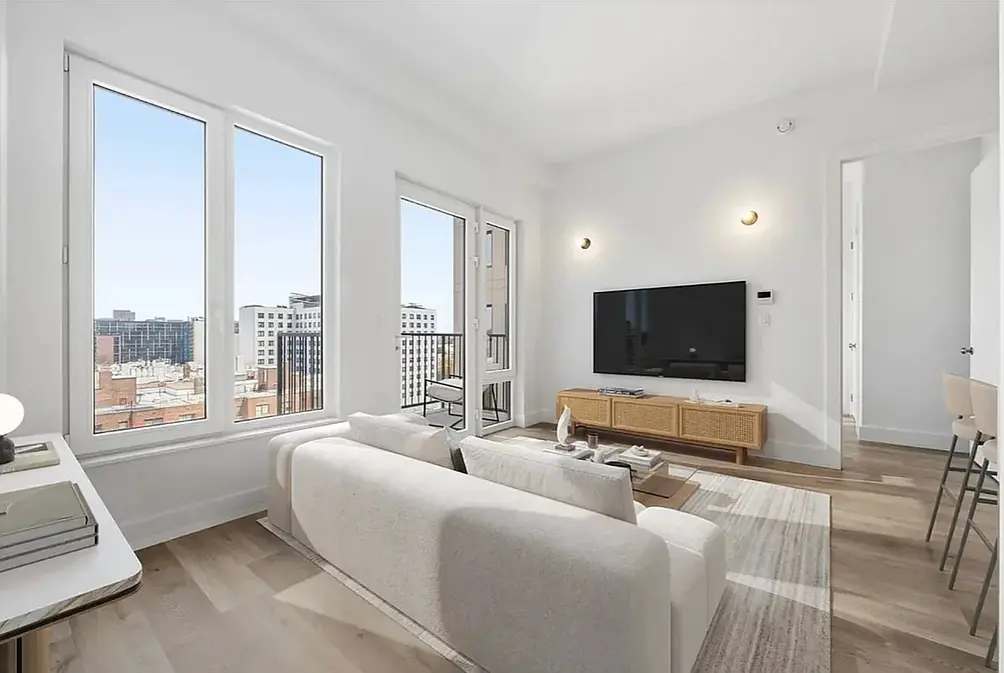 Jamaica Central living room (Living New York)
A double-height marble lobby welcomes residents and sets the tone for life at Jamaica Central. A thoughtfully curated amenity package includes a fitness center, a coworking lounge with private work stations, and a rooftop terrace. It is located a short distance from Rufus King Park, popular local restaurants, and the Jamaica Center-Parsons Avenue E, J, and Z trains.
 Roof terrace (Housing Connect)
19 East 198th Street and 21 East 198th Street, Fordham
Developed by AG Holdings Group
Design by Angelo Ng and Anthony Ng Architects
11 stories | 166 units
Developed by AG Holdings Group
Design by Angelo Ng and Anthony Ng Architects
11 stories | 166 units
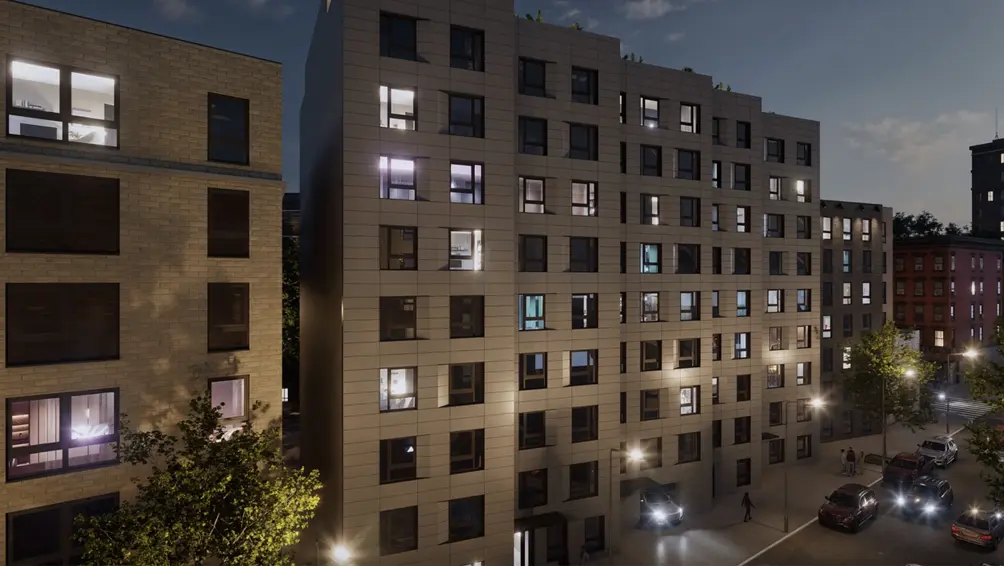 19 and 21 East 198th Street (Angelo Ng and Anthony Ng Architects)
A ribbon-cutting ceremony recently took place for a pair of newly completed rentals in the Fordham section of the Bronx. They bring a total of 166 new housing units to the neighborhood, and 34 have been designated affordable to households earning 80 percent of the Area Median Income; however, this lottery has not been announced yet. In a statement about the project, Bronx Borough President Vanessa L. Gibson said, "Every new affordable home created here in the Bronx helps ensure that our borough remains a place where families can truly build a future together."
According to permits, amenities in the buildings include a central laundry room, a roof terrace, bike storage, and on-site parking. They are located in close proximity to Lehman College, CUNY, restaurants lining Bedford Park Boulevard, and the Bedford Park Boulevard B/D trains.
Forthcoming Projects
Related Articles

Get To Know
Steals & Deals from $345K: Listings with "Motivated Sellers" or "Priced to Sell"
Today, July 17, 2026
Affordable Housing
The pros and cons of buying an HDFC apartment + New listings include an ultra-chic East Village co-op
Thursday, July 16, 2026
Get To Know
Could SROs help New Yorkers find affordable housing? + The best $500K buys in Manhattan today
Tuesday, July 14, 2026
Future New York
Manhattan sales stay strong as entry-level market constricts; Artist Karim Rashid says costs and taxes forced him out of NYC
Monday, July 13, 2026
Get To Know
Urban Oases: The best indoor and outdoor plants for apartments as NYC reclaims more space for greenery
Friday, July 10, 2026
Downtown Brooklyn
How NYC’s 2026 rent freeze is different from past rent freezes + New affordable housing lotteries with rent-stabilized units
Friday, July 10, 2026
Bedford-Stuyvesant
When, why, and how to get renters insurance + 10 new and forthcoming NYC rentals
Thursday, July 9, 2026
Get To Know
The gay effect on New York City real estate
Friday, June 26, 2026
Contributing Writer
Cait Etherington
Cait Etherington has over twenty years of experience working as a journalist and communications consultant. Her articles and reviews have been published in newspapers and magazines across the United States and internationally. An experienced financial writer, Cait is committed to exposing the human side of stories about contemporary business, banking and workplace relations. She also enjoys writing about trends, lifestyles and real estate in New York City where she lives with her family in a cozy apartment on the twentieth floor of a Manhattan high rise.

 6sqft delivers the latest on real estate, architecture, and design, straight from New York City.
