1001 Fifth Avenue CLOSE 
In the midst of the craze for Post Modern designs, highlighted by its open-pediment, high-boy design for a new headquarters for A. T. & T. on Madison Avenue at 56th Street, the architectural firm of Johnson/Burgee put part of a huge mansard roof atop this 76-unit cooperative apartment building.
The part was merely the front fa??ade and the "false-front" design, which can be easily seen from the north or south, was widely criticized.
"High-rise pretentiousness with an openly ersatz mansard roof whose true nature is apparent to any who care to look. An architectural conceit raised to new heights," remarked Elliot Willensky and Norval White in their book, "The A.I.A. Guide to New York City, Third Edition," (Harcourt, Brace Jovanovich, 1988).
Slanting buttresses support the tall screen roof element and while the avenue fa??ade is entirely limestone the other sides of the building are covered in buff brick.
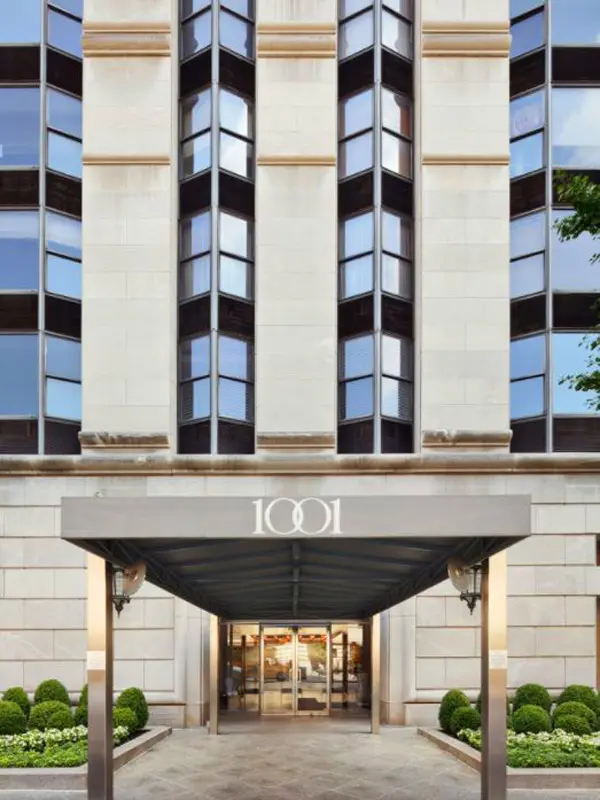
Despite its notoriety over the "billboard" roof design, however, the building is impressive at street level with a very handsome entrance and partitioning with rounded courses of the fa??ade to complement the courses and cornice line of its supremely elegant neighbor to the south, 998 Fifth Avenue designed by McKim, Mead & White.
"But the dark gray bay windows and their connecting metal spandrels form strong vertical elements that totally negate these horizontal strips. And the 'honest,' or tongue-in-cheek, gesture of stopping the moldings short of the sides of the building may be amusing for those in the know, but their use just seems unresolved. It does not help that the moldings look like sliced-off Tootsie Rolls," remarked architecture critic Ada Louise Huxtable in her book, "Architecture Anyone?" (The University of California Press, 1985).
"The entrance, however, has the elegant Johnson touch. Designed originally as a Sullivanesque arch - a feature that was abandoned - it has turned out to be the least 'reminiscent' feature and the best part of the building," Huxtable maintained.
The mansard-roof element was obviously intended to mirror the real mansard roof of its low-rise mansion neighbor just to the north, the former Benjamin N. Duke residence designed by Welch, Smith & Provot. Also to its credit is the extensive use of limestone on the avenue frontage, something that many other "luxury" high-rises opted not to do.
The division of the avenue frontage into four bays of windows, wide at the ends and narrow in the center, reflects a preoccupation with fenestration patterns by Philip Johnson and John Burgee, the design architects for this project by Peter Kalikow. The strong verticality of the window patterns, however, does not work contextually with its neighbors. Philip Birnbaum & Assocs. were the associated architects.
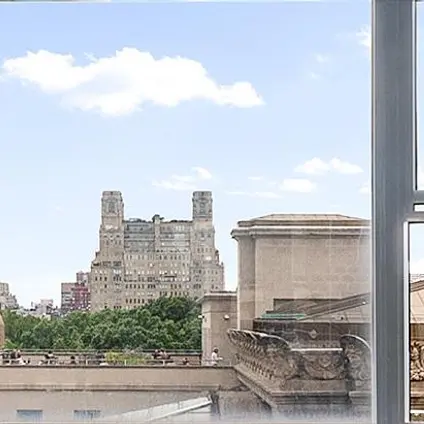
Completed in 1979, this midblock building between 81st and 82nd Streets is directly across from the Metropolitan Museum of Art.
It has a canopied entrance flanked by two large landscaped beds and very attractive hanging lanterns.
To view all NYC apartment information and prices, log in or register now it's quick, easy and free.
You'll get access to all NYC apartments available including thousands of listings all for free.

Forgot Password?
If you need assistance, please call us at 212-755-5544.
|
Comments or questions? · Phone: 212.755.5544
|
|
An equal housing opportunity.
|
| All data is deemed reliable but is not guaranteed accurate by the REBNY / RLS or CityRealty. See Terms of Service for additional restrictions. All information furnished regarding New York City property for sale, rental or financing is from sources deemed reliable, but no warranty or representation is made as to the accuracy thereof and same is submitted subject to errors, omissions, change of price, rental or other conditions, prior sale, lease or financing or withdrawal without notice. All dimensions are approximate. For exact dimensions, you must hire your own architect or engineer. The number of bedrooms listed on this website is not a legal conclusion. Each person should consult with his/her own attorney, architect or zoning expert to make a determination as to the number of rooms in the unit that may be legally used as a bedroom. |