
Many New Yorkers enjoy "bishop's crook" streetlights and are happy that the old favorites are reappearing as replacements for the minimalist "goose-necks" in some neighborhoods. One problem: These lights, which overhang streets rather than sidewalks, mostly benefit cars, not pedestrians, and they are certainly not optimal for neighborhood residents.
One solution is mounting lights on, as opposed to in, individual buildings. Sadly, not every building has an illuminated top, to say nothing of an illuminated bottom. Some of the better apartment buildings, especially pre-wars, do have lights, often mounted like sconces on the walls on either side of the entrance.
These lights are generally unobtrusive and provide only minimal illumination -- enough, say, to discern which is the front-door key, read front-page newspaper headlines while waiting for your date to come downstairs, or to see which side of the matchbook to strike when lighting a cigarette. The city's chandelier crowd deserves better, and the Sherry-Netherland Hotel, at 781 Fifth Ave. at 59th Street, delivers. When not checking out the time at its impressive clock stanchion, visitors may want to cast eyes back toward the building and upwards: They won't be able to see its spectacular spire, but the glorious hanging lanterns that are suspended from the mouths of large dragons will engage, if a bit frightfully. Staring at these dragons could be the New York equivalent of Rocky dancing on the steps of the Philadelphia Museum of Art. Just be sure not to let the children see them, or they won't be satisfied with the available dragons at F.A.O. Schwarz toy store just down the avenue. A few blocks north, at 820 Fifth Ave., one of the city's most elegant pre-war apartment buildings sports an attractive pair of hanging lanterns. The building, designed by Starrett & Van Vleck, was erected in 1916.
Farther north, at 1001 Fifth Ave., across from the Metropolitan Museum of Art, is a 22-story apartment building designed by Philip Johnson. The limestone-clad 1979 structure, most famous for its "false-front" roof treatment, is also notable for a quite handsome pair of hanging lanterns flanking its entrance, demonstrating that detailing was a not totally lost art in the post-war era.
This article was previously published by the New York Sun.
www.nysun.com/real-estate/light-touch/68855/
One solution is mounting lights on, as opposed to in, individual buildings. Sadly, not every building has an illuminated top, to say nothing of an illuminated bottom. Some of the better apartment buildings, especially pre-wars, do have lights, often mounted like sconces on the walls on either side of the entrance.
These lights are generally unobtrusive and provide only minimal illumination -- enough, say, to discern which is the front-door key, read front-page newspaper headlines while waiting for your date to come downstairs, or to see which side of the matchbook to strike when lighting a cigarette. The city's chandelier crowd deserves better, and the Sherry-Netherland Hotel, at 781 Fifth Ave. at 59th Street, delivers. When not checking out the time at its impressive clock stanchion, visitors may want to cast eyes back toward the building and upwards: They won't be able to see its spectacular spire, but the glorious hanging lanterns that are suspended from the mouths of large dragons will engage, if a bit frightfully. Staring at these dragons could be the New York equivalent of Rocky dancing on the steps of the Philadelphia Museum of Art. Just be sure not to let the children see them, or they won't be satisfied with the available dragons at F.A.O. Schwarz toy store just down the avenue. A few blocks north, at 820 Fifth Ave., one of the city's most elegant pre-war apartment buildings sports an attractive pair of hanging lanterns. The building, designed by Starrett & Van Vleck, was erected in 1916.
Farther north, at 1001 Fifth Ave., across from the Metropolitan Museum of Art, is a 22-story apartment building designed by Philip Johnson. The limestone-clad 1979 structure, most famous for its "false-front" roof treatment, is also notable for a quite handsome pair of hanging lanterns flanking its entrance, demonstrating that detailing was a not totally lost art in the post-war era.
This article was previously published by the New York Sun.
www.nysun.com/real-estate/light-touch/68855/
Related Articles
Goldilocks Blocks
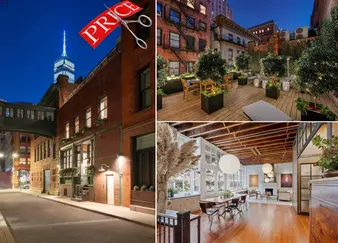
Price Cuts: Sumptuous Staple Street townhouse slashed by $8M; Pulitzer Mansion penthouse now 37% off
Wednesday, May 20, 2026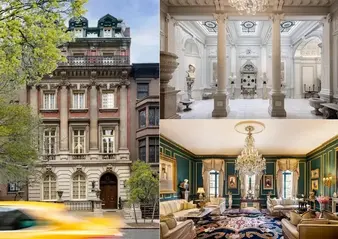
Future New York
Classical elegance triumphs among top NYC deals; Kuwaiti billionaire sells Gilded Age mansion with steep markdown
Monday, May 11, 2026
Future New York
Where buildings meet the sky: The return of the cornice, from Fifth Avenue to Lispenard Street
Wednesday, April 15, 2026
Future New York
New York’s Classical Revival: See the new Penn Station and traditional designs reshaping the luxury residential market
Wednesday, June 24, 2026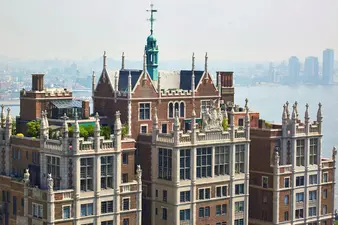
Great Listings
Tudor City at 100: Rich history and attractive listings from $309K at Turtle Bay city-within-a-city
Wednesday, June 24, 2026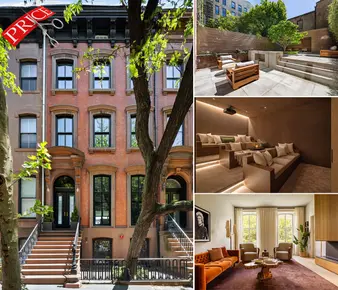
Future New York
Price Cuts: "Big" screenwriter's Cobble Hill townhouse trimmed by $900K; Lantern House junior penthouse drops below $10M
Wednesday, June 24, 2026
Future New York
Landmarks praises residential conversion/restoration of NoMad's Baudouine Building, Seeks revisions to rooftop addition
Tuesday, June 23, 2026
Iconic Addresses
Paul Newman's parkside office sells 47% over ask; Pre-war condo conversions lead Manhattan sales
Tuesday, June 23, 2026
Architecture Critic
Carter Horsley
Since 1997, Carter B. Horsley has been the editorial director of CityRealty. He began his journalistic career at The New York Times in 1961 where he spent 26 years as a reporter specializing in real estate & architectural news. In 1987, he became the architecture critic and real estate editor of The New York Post.

 6sqft delivers the latest on real estate, architecture, and design, straight from New York City.
