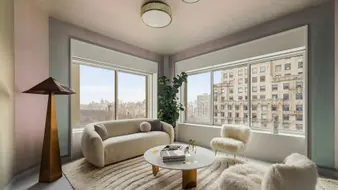
223 East 66th Street CLOSE
This pleasant, mid-block row of six-story buildings contains 245 apartments and face the mammoth slab of Manhattan House, the full-block apartment complex between Second and Third Avenues and 65th and 66th Streets.
These former tenements were acquired by New York Life Insurance Company to serve as "light-protectors" and "view-protectors" for its Manhattan House project that was erected in 1960. The insurance company painted them gray with white trim to complement the light-gray-brick Manhattan House. The buildings have four-step-up entrances, protruding air-conditioners, fire escapes, sidewalk landscaping, and no doormen, no garages, and no health clubs.
One of the most influential post-war buildings in New York City, Manhattan House marked the beginning of the age of "white-brick monstrosities" in the eyes of some observers and the first big splash of International Style modernity in the city to others.
The mammoth development, which occupies the full block between Third and Second Avenues and 65th and 66th Streets, actually is clad in a light gray-brick, but niceties aside it presented a "clean," "neat," almost Spartan appearance in distinct contrast to the historical styles of earlier periods and the Art Deco stylizations of the 1920s and 1930s.
Designed by Skidmore, Owings & Merrill and Mayers & Whittlesley, it was built in 1950 and was, according to Robert A. M. Stern, Thomas Mellins and David Fishman in their superb book, "New York 1960 Architecture and Urbanism Between The Second World War And The Bicentennial," (The Monacelli Press, 1995), "the most literal manisfestation in New York of Le Corbusier's postwar conception of vertical living, which the master himself was not to realize until 1952 in his Unit? d'Habitation at Marseilles."
"Together with elegantly thin window frames of white-painted metal and carefully detailed balconies," the authors continued, "the glazed brick rendered Manhattan House a genteel manifesto for architecture's brave new world, a reassuring statement that Modernist minimalism had more than cost benefits. In addition, the slab offered a distinct contrast with its mundane surroundings - the still-functioning Third Avenue El and its immediate neighbors, mostly old- and new-law tenements....The principal innovations of Manhattan House were the bold scale resulting from its single-slab configuration; the departure from traditional urban space making in the refusal to hold the street front except at the base; and the blurring of distinctions between exterior and interior space, as well as front and back yards, by the use of large amounts of glazing at the lobby level. In discussing this last point, the editors of Architectural Record, presumably quoting form a New York life press release, said that 'the entire development carries out on a large scale, in a big city, an indoor-outdoor synthesis hitherto found mostly in modern country homes.'"
The insurance company also protected its investment and views by erecting a low-rise commercial structure that included the Beekman movie theater at 1254 Second Avenue across from Manhattan House.
The insurance company originally had acquired not only the block on which Manhattan House is sited, but also the block just to the south for which it planned a large parking garage topped by a public park. Three hundred of the garage's 1,400 parking spaces were to be reserved for the residents of Manhattan House. The plans were this block, however, would be shelved.
Manhattan House is a 19-story building with 581 apartments, many with balconies. Air-conditioning was not included when it was completed, although it permits protruding air-conditioners.
Gordon Bunshaft, the principal architect with Skidmore, Owings & Merrill for the project, took an apartment for himself at Manhattan House and at one time Grace Kelly, the actress, also rented an apartment.
The building, which has a roof deck, has give projecting bays, each with two balconies and its entrances are along a curved driveway on 66th Street, which was widened on this block because of the project. There are several entrances along the driveway, which is lushly landscaped and the lobbies have floor-to-ceiling windows that permit views from the driveway through to the development's large gardens on the south side, that are walled from 65th Street. A one-story commercial base along Third Avenue originally housed a large Longchamps restaurant that had its own outdoor terrace facing the gardens.
Although scores of apartment houses on the Upper East Side would try to mimic the success of Manhattan House with light-colored brick facades and balconies, there were not too many full-block opportunities. One that is somewhat similar, however, is Imperial House, which was designed by Emery Roth & Sons in 1960 and is nearby at 69th Street and Third Avenue and also features extensive gardens and a very large, windowed lobby but has a center tower.
This section of Third Avenue has been subsequently developed with many luxury apartment towers and there is convenient local shopping and good public transportation.


All Manhattan Apartment Buildings|
Comments or questions? · Phone: 212.755.5544
|
|
An equal housing opportunity.
|
| All data is deemed reliable but is not guaranteed accurate by the REBNY / RLS or CityRealty. See Terms of Service for additional restrictions. All information furnished regarding New York City property for sale, rental or financing is from sources deemed reliable, but no warranty or representation is made as to the accuracy thereof and same is submitted subject to errors, omissions, change of price, rental or other conditions, prior sale, lease or financing or withdrawal without notice. All dimensions are approximate. For exact dimensions, you must hire your own architect or engineer. The number of bedrooms listed on this website is not a legal conclusion. Each person should consult with his/her own attorney, architect or zoning expert to make a determination as to the number of rooms in the unit that may be legally used as a bedroom. |