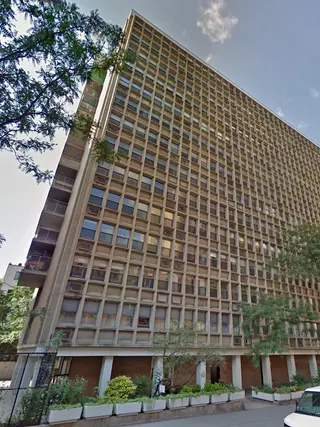
RNA Houses at 132 West 96th Street is a 14 story co-op building erected in 1967 as part of the West Side Urban Renewal Project. Developed by Riverside Neighborhood Assembly and designed by Edelbaum & Webster, the building contains 208 apartments and stands as one of the city's largest mid block residential complexes. Its design draws inspiration from the slightly earlier Kips Bay Plaza development by I. M. Pei, featuring a distinctive honeycomb façade that has been described as a "concrete beehive."
The building's uniform, cellular design and fine proportions make it one of the more architecturally successful developments to emerge from the urban renewal project. While it lacks the grandeur of a fully freestanding structure, the building effectively addresses the street wall of this important crosstown corridor, set slightly back from the building line with generous sidewalk landscaping and a three step up entrance.
Amenities include a live-in superintendent and garage. RNA Houses was one of four middle income housing developments first planned for the West Side Urban Renewal Project in summer 1963, alongside Strycker's Bay Apartments (234 apartments in 16 and 20 story buildings), Goddard Riverside House (194 apartments in a 27 story building), and Columbus Park Towers (161 apartments in a 26 story tower).