 Carter Horsley
Aug 15, 2017
Carter's Review
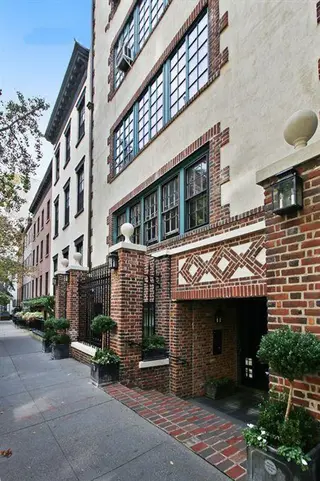
This very handsome, 7-story, mid-block apartment building at 132 East 19th Street between Irving Place and Third Avenue was a brownstone building that was redesigned in 1908 by Frederick Sterner and is now a co-operative with 19 apartments.
Bottom Line
An elegant, 7-story, mid-block, red-brick and cream-colored stucco apartment building on “block beautiful” just to the south of Gramercy Park.
Description
The building has a three-step-down entrance next to a tall fence with four red-brick stanchions topped by globular finials. The entrance vestibule is faced with a pattern of two diamonds in red brick against a cream-colored stucco background.
The building has a stucco façade with broad windows centered on its framed in red brick that is laid in broadly spaced quoin fashion as are the building’s east and west edges.
There is a broad, red-brick bandcourse above the 6th floor and the 7th floor has a large skylight flanked by protrusions at the base the building’s mansard roof.
Amenities
The building has an intercom, a garden, a bicycle room and wood-burning fireplaces.
Apartments
Apartment 7F is a two-bedroom duplex with a 16-foot-long entry gallery that leads past an 8-foot-wide enclosed kitchen to a 27-foot-wide, double-height living/dining room with a wood-burning fireplace and a large skylight and a staircase in the gallery on the lower level goes to the 16-foot-wide attic loft.
Apartment 6F is a two-bedroom unit with a long entry foyer that leads past an enclosed 9-foot-long kitchen to a 28-foot-wide living/dining room with a wood-burning fireplace.
Apartment 4F is a two-bedroom unit with a 27-foot-wide living/dining room with a wood-burning fireplace and an enclosed kitchen.
Apartment 7E is a one-bedroom unit with a long entry foyer that leads past a 7-foot-long, enclosed kitchen to an 18-foot-long living room with a wood-burning fireplace. The bedroom has an angled bathroom.
History
In his June 29, 2003 “Streetscapes” column in The New York Times, Christopher Gray wrote that this “was the first building designed in New York by Frederick Sterner, one of the city’s most innovative architects,” adding that his “complete redesign and renovation of an existing building – which he did for himself -was a major achievement for Sterner, then a newcomer to New York, who would go on to bring a touch of color to several of Manhattan’s drab brownstone side streets.”
“What to do with mid-19th Century brownstones – built by the mile, of identical boring design, awkwardly planned and often poorly constructed – was a subject that puzzled writers at the time, and the question was in the air when Sterner arrived. His earlier projects offered no hint of what he was to introduce in New York. He removed the stoop, covered the dark brownstone with a coat of light cream-colored stucco and replanned the interior. It is now a common approach, but nothing like it had been done in New York before. Perhaps by design, Sterner’s architectural sleight of hand sparked a wave of renovations on the block. Within a few years, several rebuilders changed the East 19th Street block into one of tinted stucco, iron balconies, Arts and Crafts style tilework, flower boxes and projecting tile roofs, mostly in a Mediterranean style and clearly embodying a new vision for an aging city. In 1910, The Real Estate Record and Guide praised Sterner’s back yard. It said he had turned what had been a traditionally dank space with board fences into a ‘fairylike grotto’ with vine-clad walls, an arbor and a fountain.”
“Sterner remained on East 19th Street until 1915,” Mr. Gray continued, “when he moved up to and renovated 154 East 63rd Street, which became the center of another enclave of remodeled houses. He moved again around 1918 to 150 East 62nd Street, and that became the center of another coordinated remodeling effort. Around this time the architect Rosario Candela – who in the 1920’s would design a series of superluxury buildings on Park Avenue – worked for Sterner, but little is known of Candela’s role or of Sterner’s office.”
Mr. Gray concluded his article by noting that “Although Sterner was among the most thoughtful and original architects in the history of the city, the preservation of his ‘gypsy music’ has frequently hit sour notes,” adding that “The Landmarks Preservation Commission included the 19th Street block in the Gramercy Park Historic District in 1966 but treated it as a generic group of buildings, without mentioned Sterner.” “His light artistic designs,” he continued, “do not figure in the traditional architectural canon, and so seem incidental, even trivial.”
- Co-op built in 1920
- Located in Gramercy Park
- 19 total apartments 19 total apartments
- 10 recent sales ($695K to $2.7M)
- Small Pets Allowed only


 6sqft delivers the latest on real estate, architecture, and design, straight from New York City.
