
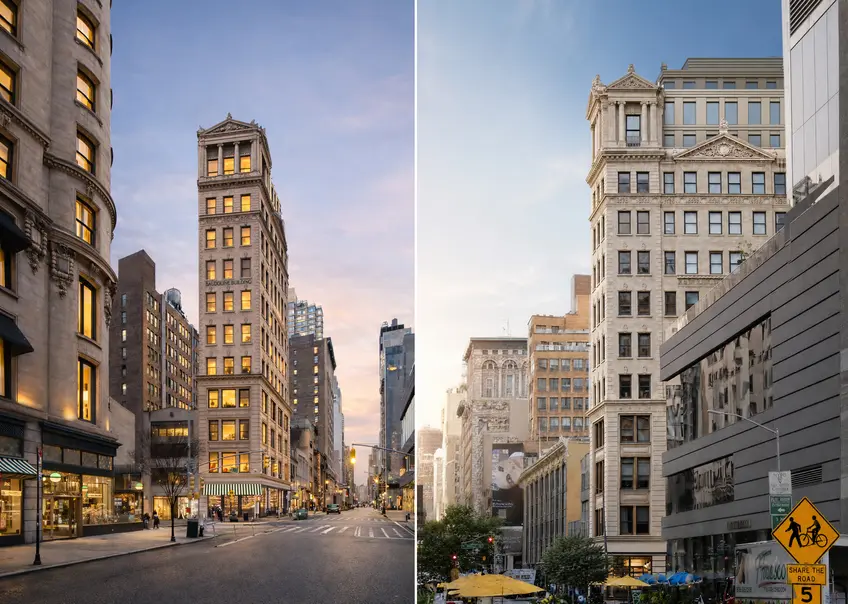
A landmarked NoMad office building crowned by one of Manhattan's most unusual rooftops, a little temple, is poised for a residential conversion. Alf Naman Development plans to transform the 1896 Baudouine Building at 1181 Broadway into high-end apartments (condos likely), pairing a comprehensive restoration with a new rooftop addition designed by Brooklyn-based Bench Architecture.
At a Landmarks Preservation Commission hearing earlier today, commissioners enthusiastically supported the restoration and adaptive reuse of the building, but stopped short of approving the proposal. Instead, they voted "No Action," asking the design team to revise the penthouse addition so it relates more sensitively to the building's distinctive Greco-Roman temple. As one commissioner put it, the challenge is maintaining the temple's "hierarchy" as the building's defining architectural feature.
In this article:
Completed in 1896, the building was developed as a speculative office and retail property for the estate of cabinetmaker and real estate investor Charles A. Baudouine. Designed by prolific architect Alfred Zucker, it rose during a period when Broadway around Madison Square was transforming into a bustling commercial corridor.
The building's most celebrated feature is its rooftop temple, a two-story Greco-Roman pavilion adorned with Ionic columns and a triangular pediment. Former New York City Landmarks Preservation Commission, Sherida E. Paulsen, called it "a little Parnassus in the sky." Initial historical drawings of the building showed the builders weren't going to stop there but envisioned a grand cupola atop their adorable tempietto.
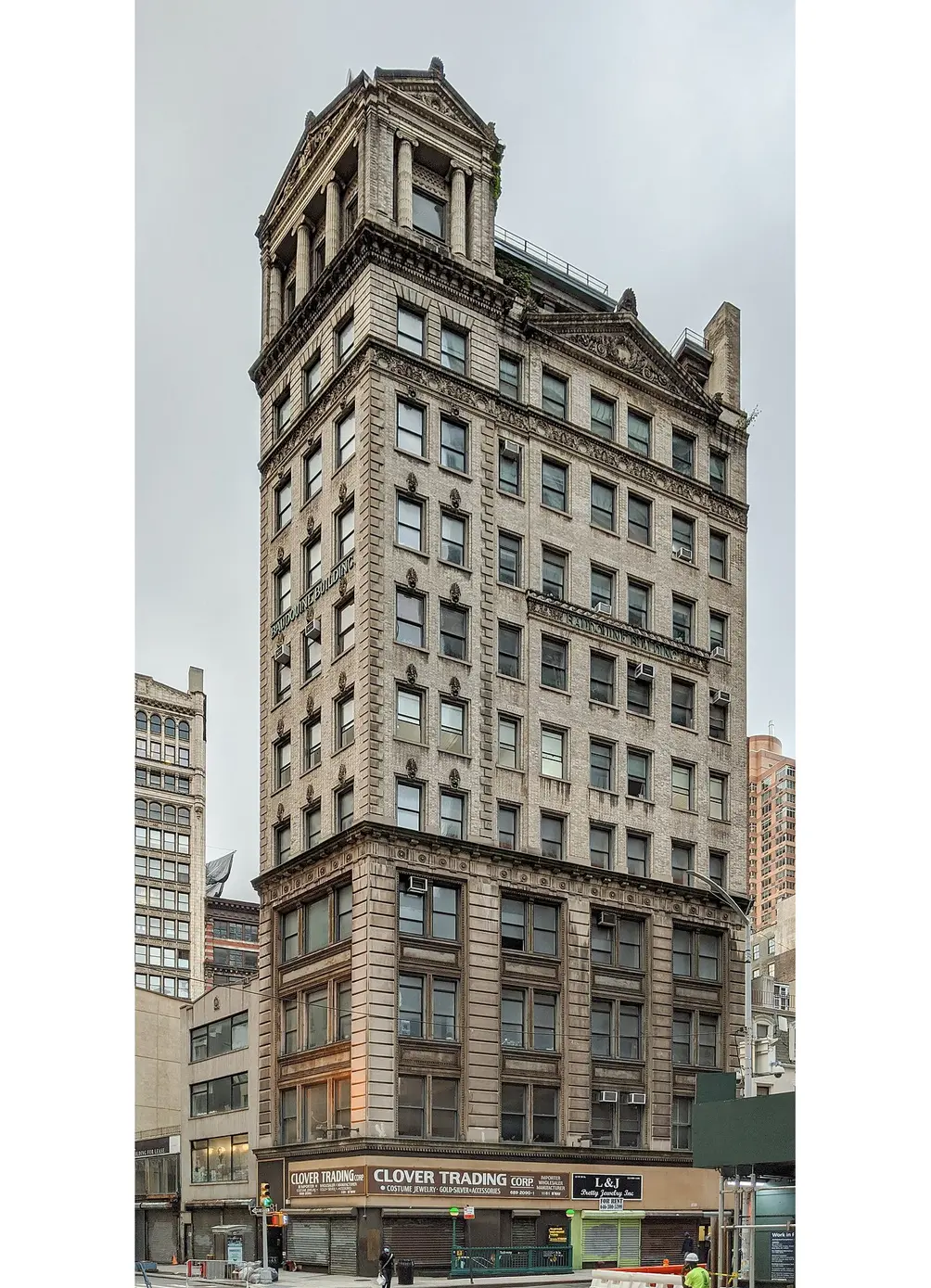 Baudouine Building by Eden, Janine and Jim from New York City - Baudouine Building, CC BY 2.0, https://commons.wikimedia.org/w/index.php?curid=107434489
Anchoring the southwest corner of Broadway and West 28th Street, the narrow structure rises on a postage stamp size lot and was designed to command attention with bold terra-cotta ornamentation, paired windows, and prominent "BAUDOUINE BUILDING" lettering to help distinguish it from neighboring loft buildings.
Historic maps show the building surrounded by theaters, hotels, and commercial lofts. Over the decades it housed architects, contractors, publishers, clothing merchants, and even actress Julia Arthur, who reportedly maintained offices there while promoting a stage production of Hamlet.
When the Baudouine Building opened in 1896, this stretch of Broadway was at the center of New York's booming "Ladies' Mile" shopping district. Department stores, specialty retailers and showrooms lined the avenue, helping transform the stretch into one of the city's premier commercial corridors.
Since its completion, the structure has evolved from a bustling Gilded Age commercial district to the Garment Center's southern edge. After decades of decline and a more pedestrianized Broadway, NoMad is one of Manhattan's most sought-after mixed-use neighborhoods.
The conversion proposal arrives at a moment when heavily commercial Midtown South is poised to receive more apartments. The area's recently approved rezoning opened large swaths of NoMad and northern Chelsea to residential use for the first time in decades, creating opportunities to convert aging office buildings into housing. The Baudouine Building is among the first prominent candidates to test the new zoning.
While the upper stories remain mostly intact, the storefront level tells a different story and most recently held an illegal cannabis shop. Over the years, successive retail tenants introduced metal panels, oversized signage, and roll-down security gates that gradually obscured the building's original appearance.
One of the most widely praised aspects of the proposal by LPC commissioners is the restoration of the ground floor. Historic photographs show the building had large display windows and inviting storefront entrances. The new design recreates those generous openings and reinstates awnings that once animated the Broadway corner.
Commissioners praised the restoration plans. One described the work as "a wonderful job, especially on the ground floor," while another highlighted the effort to make the façade more symmetrical and welcoming. The proposed storefront restoration drew virtually no criticism during the hearing.
The project calls for extensive masonry repairs, terra-cotta restoration, cast-iron rehabilitation, façade cleaning, and replacement of inappropriate windows. The goal is not to reinvent the building, but to reveal details that have been hidden by age and piecemeal alterations.
The roof today is crowded with a cacophony of bulkheads, mechanical equipment, a water tank, and deteriorated secondary structures. Bench Architecture argues that removing these elements would simplify the roofscape and allow the temple to emerge as the visual centerpiece.
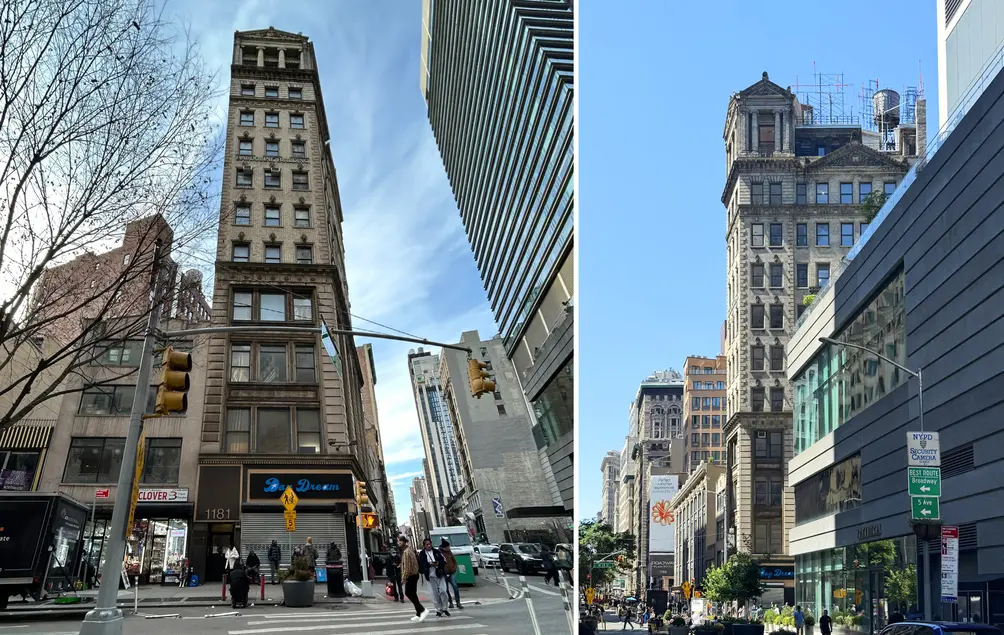 Photo showing rooftop mockup built to visualize the scale of the new addition
The design team described the rooftop addition as an attempt to create a coherent backdrop for the temple. "We want the temple to stand out as a dynamic element of the composition," the architects told commissioners, explaining that the proposal would consolidate rooftop clutter and reduce the visual prominence of mechanical equipment.
Converting the former loft office building into housing requires substantial upgrades behind the scenes. Plans include a new ADA-compliant elevator, modern building systems, and code-compliant egress stairs. The improvements that will allow the 19th-century building to function as a residential building. Early floor plans from the presentation convey the apartments will be spacious and most likely attuned for the high-end condo market.
Directly, across Broadway from the structure is the 2017-converted Centurian Building, and across 28th Street, The Ritz-Carlton Residences, New York, NoMad
Landmarks commissioners were unconvinced. While they appreciated the restoration work, several felt the new addition borrowed too heavily from the building below. One commissioner argued that the penthouse "reduces [the temple's] importance" because it echoes the same rhythms, materials, and architectural language.
The concept of hierarchy emerged as the central issue of the hearing. Commissioners repeatedly stressed that the temple should remain the dominant feature. "The historic photos clearly demonstrate that this temple element was meant to be of the most important level of hierarchy," one commissioner said, suggesting that a more differentiated design might better preserve that relationship.
Despite the "No Action" vote, the hearing was overwhelmingly positive. Commissioners praised the residential conversion, the façade restoration, and the investment in the historic structure. The board asked the team to come back with refinements to the rooftop addition and a stronger emphasis on the temple's prominence in order to gain full approval.
Would you like to tour any of these properties?
Related Articles
Iconic Addresses
Paul Newman's parkside office sells 47% over ask; Pre-war condo conversions lead Manhattan sales
Today, June 23, 2026
Get To Know
What is a sponsor unit? Pros, cons, and NYC apartments with no board approval required from $165K
Today, June 23, 2026
Future New York
NYC contracts led by $18.5M Upper East Side mansion and a bespoke Billionaires' Row condo
Today, June 23, 2026
Get To Know
How property values are assessed in NYC + Great new listings with open houses from $445K
Saturday, June 20, 2026
Get To Know
Swim with a View: 30 Manhattan buildings with high-floor swimming pools and fitness centers
Saturday, June 20, 2026
Future New York
Brick is Back: NYC developments revive the warmth of masonry; See Morris Adjmi's new design for 277 Canal Street
Friday, June 19, 2026
Coney Island
Knicks in Five: 35 NYC condo and rental buildings with basketball courts
Thursday, June 18, 2026
Future New York

 6sqft delivers the latest on real estate, architecture, and design, straight from New York City.
