
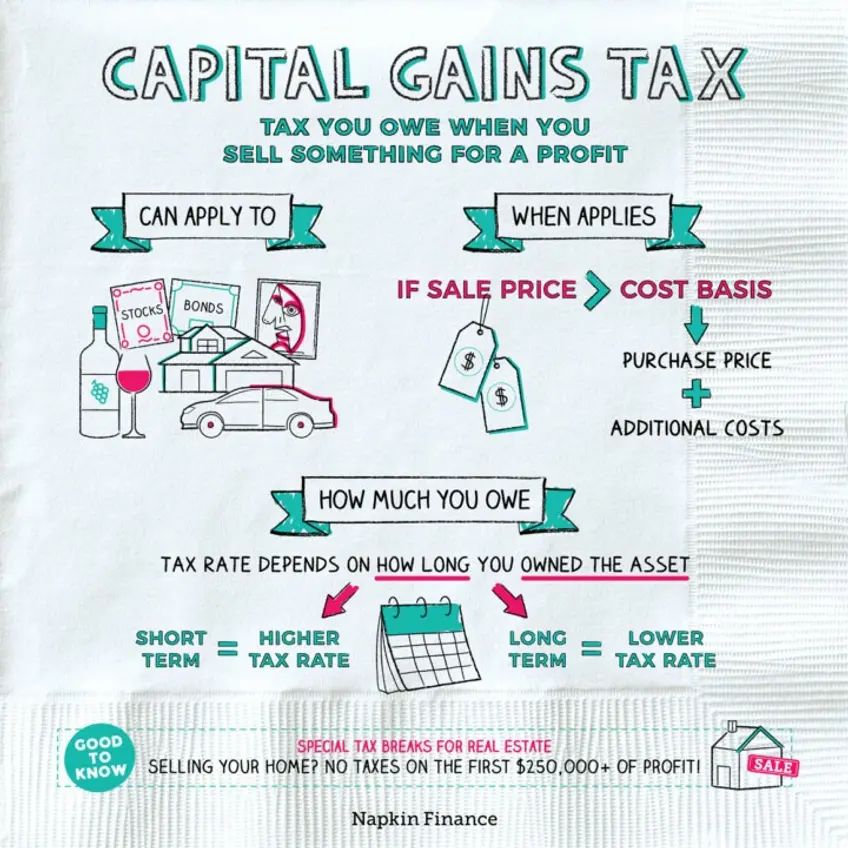
When you sell a residential property in New York City, there is a possibility that you’ll be required to pay capital gains tax on the sale. This article explains when capital gains tax applies and when and how you may qualify for an exemption.
In this article:

What Are Capital Gains?
As outlined on the IRS website, virtually everything you own and use for personal or investment purposes is considered a capital asset. This includes not only your home but also other personal-use items, from furnishings to stocks and bonds. When you sell these capital assets, the difference between the asset’s adjusted basis and the amount you realize from the sale is treated as a capital gain or, if you didn’t realize a gain, as a capital loss.
When You Must Pay Capital Gains Tax on a Property Sale
If you sell a property in New York City and realize a gain, you may be subject to capital gains tax. But there are also many conditions under which you may pay nothing at all.
Under current federal law, homeowners can exclude up to $250,000 in capital gains if filing individually and up to $500,000 if married and filing jointly on gains related to the sale of a primary residence. Still, there are a few caveats. To qualify for this exemption, you must have owned and lived in the property for at least two of the past five years (the two years do not need to be consecutive). There are also special rules that apply to certain members of the military and qualifying federal service members who may be living abroad or on a base due to their job.
On the flip side, if you didn’t own and occupy your unit for at least two of the past five years and your gain exceeded $250,000 for a single filer or $500,000 for a married couple filing jointly, you will owe on your gain, but only on the amount exceeding the threshold. For example, if your gain was $350,000, only $100,000 of the gain would generally be subject to capital gains tax, rather than the full amount.
Potential Carve-Outs for Capital Improvements
While there is no guaranteed way to avoid paying capital gains tax if your gain exceeds the applicable exclusion, homeowners can often reduce or even eliminate their taxable gain by increasing their property’s adjusted basis through qualifying capital improvements. Capital improvements are one of the most common ways homeowners reduce their potential capital gains liability.
As an example, let’s say you purchased a fixer-upper for $600,000 in 2020 and, over a roughly six-year period while owning and occupying the unit, invested $175,000 in qualifying capital improvements, and subsequently put the unit back on the market for $1.3 million. As per current IRS guidelines, which also factor in eligible selling expenses such as broker commissions, legal fees, and transfer taxes, your calculation would look like this:
- Adjusted basis = $600,000 (original purchase price) + $175,000 (capital improvements) = $775,000
- Amount realized = $1,300,000 (sale price) − $80,000 (eligible selling expenses) = $1,220,000
- Capital gain = $1,220,000 − $775,000 = $445,000
In the above scenario, a single filer would still pay capital gains tax on part of the gain ($195,000), while a married couple filing jointly would generally owe no federal capital gains tax because the gain falls below the $500,000 exclusion.
 This home at 595 West End Avenue #14 recently resold at a gain of $1,422,600 and will likely be subject to capital gains taxes | https://www.cityrealty.com/nyc/riverside-dr-west-end-ave/595-west-end-avenue/3093/14
Rules for Investment Properties, Second Residences, and Inherited Properties
While capital gains taxes can often be avoided or at least reduced on owner-occupied residential properties, this is generally not the case for rental apartments, investment properties, vacation homes, and most pieds-à-terre.
Capital gains on rental and investment properties
If you sell a rental unit, you’ll generally be subject to federal capital gains tax on any profit from the sale. Depending on your taxable income, long-term capital gains are currently taxed at rates of 0%, 15%, or 20% at the federal level. In addition, some higher-income taxpayers may also owe the 3.8% Net Investment Income Tax, and New York State also taxes capital gains as ordinary income.
Unlike a primary residence, rental and investment properties can generally be depreciated. This allows owners to deduct a portion of the building’s value each year as a non-cash expense, even if the property’s market value is appreciating. These annual depreciation deductions reduce taxable rental income and improve cash flow, making depreciation one of the most significant tax advantages of real estate investing. However, depreciation also reduces a property’s adjusted basis. As a result, when the property is eventually sold, the owner’s taxable gain may be higher than expected.
Vacation homes
Vacation homes generally do not qualify for the exclusions that apply to principal residences, nor for the depreciation deductions that apply to rental properties. Fortunately, owners can still reduce their taxable gain by accounting for qualifying capital improvements, including major renovations, additions, or structural upgrades. They can also reduce their taxable gain by deducting eligible selling expenses, including real estate commissions, legal fees, and certain transfer taxes. If a second home was also used as a rental property, it may also be eligible for related deductions.
Capital gains on pied-a-terre
In most cases, a pied-à-terre will be treated like any other second home for tax purposes, which means it does not qualify for the $250,000 exclusion (or $500,000 for most married couples filing jointly). However, if a pied-à-terre later became the owner’s principal residence for two or more years during a five-year period, different rules may apply. Likewise, if the property was used as a rental, additional tax rules—including depreciation and depreciation recapture—may be applicable.
Capital gains on inherited homes
One important exception to the general rules outlined in this article pertains to inherited properties. In most cases, rather than using the deceased owner’s original purchase price to calculate capital gains, the property’s basis is adjusted to its fair market value as of the date of death. As a result, heirs often owe little or no capital gains tax if they sell the property relatively soon after inheriting it.
For example, if one’s parent bought an apartment in the 1970s for just $70,000, and the property is sold by the child for $1 million, the “gain” would not be $930,000 minus closing costs. As an inherited property, the gain would only be based on the estimated value of the property as of the date of the parents’ death. If the property is sold within the first year or so after the parents’ death, this will likely mean there is no significant gain and no capital gains tax owed.
For more information on how capital gains apply to property sales, refer to the IRS Selling Your Home Guide.
Other Taxes That Apply to Property Sales in New York City
Capital gains tax is just one of several taxes and closing costs that may apply to the sale of residential property in New York City. Depending on the transaction, sellers may also be responsible for New York State and New York City transfer taxes, as well as legal fees, broker commissions, and other closing costs.
Related Articles
Get To Know
Gallery Gossip Girl: The Extraordinary in the Ordinary +Extraordinary listings with room for an art collection
Saturday, October 24, 2026
Roosevelt Island
Scary Good Listings: Availabilities in haunted NYC properties
Saturday, October 24, 2026
Future New York
12 newly revealed NYC projects include the condo transformation of the MONY Building and 3 new housing lotteries
Friday, October 23, 2026
Future New York
Fireplaces in NYC homes: The romance, reality and listings to warm up to
Friday, October 23, 2026
Future New York
Beyond the Summer House: Teresa Minnick on selling The Atlantic Club, and Jersey Shore's year-round rise
Tuesday, October 20, 2026
Future New York
Mint Condition Condos: 21 new Brooklyn and Queens condos launching sales this fall
Saturday, October 17, 2026
Get To Know
12 in-demand Broadway and off-Broadway openings for fall 2026
Saturday, October 17, 2026
Get To Know
See Things Differently: Lichtenstein’s first NYC retrospective in 30+ years, Siena’s Renaissance bronzes, and more art shows this weekend
Friday, October 16, 2026
Contributing Writer
Cait Etherington
Cait Etherington has over twenty years of experience working as a journalist and communications consultant. Her articles and reviews have been published in newspapers and magazines across the United States and internationally. An experienced financial writer, Cait is committed to exposing the human side of stories about contemporary business, banking and workplace relations. She also enjoys writing about trends, lifestyles and real estate in New York City where she lives with her family in a cozy apartment on the twentieth floor of a Manhattan high rise.

 6sqft delivers the latest on real estate, architecture, and design, straight from New York City.
