541 Broadway Review
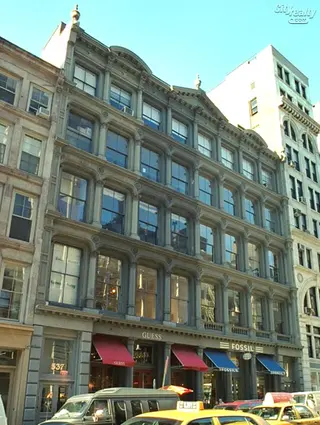
This attractive, through-block building in SoHo-Cast Iron Historic District at 112 Mercer connects to 541 Broadway between Prince and Spring Streets. It was converted to a co-operative in 1974.
Nos. 537-539 and 541 are, according to the district’s designation report, “two picturesque cast-iron buildings with a common façade designed by Charles Mettam in 1868 for Gilsey and Beekman.”
The building has ground-floor retail spaces.
Bottom Line
A through-block site with a fabulous history at a prime location in SoHo with large apartments and good retail.
Description
“The five-story, eight-bay façade is defined by a rhythmic series of columns separating the windows. The columns are plain, but have Corinthianesque capitals. A rope-molding edges the windows. Above the columns a rosette motif decorates the spandrels. A balustrade adds interest to the base of the second-story windows on No. 541. After a fire in 1883, the balustrade was removed from 537-539, and the first floor entablature was replaced by a highly foliated one, also of cast iron. The ground floor has been completely altered. The most eye-catching element of the eight-bay façade is the main entablature and roof line. A paneled frieze is interspersed by scrolled brackets supporting the cornice with its modillions. A large pediment with an urn at its peak crowns the two central bays. Two smaller curved pediments emphasize the side bays. Two urns at the ends of the façade further emphasize the roof line. The urns themselves have unique center finials,” the designation report maintained.
The building at 112 Mercer Street is a 6-story cast-iron building with deeply inset windows and bandcourses at each floor beneath an attractive, bracketed cornice that sadly is interrupted by a fire-escape. The building fronts on a cobblestone street.
Amenities
High ceilings.
Apartments
Apartment 4D at 541 Broadway is a full-floor-unit with three bedrooms, a 19-foot-wide entrance foyer off the elevator landing that opens onto a 33-foot-long living/dining room with a free-standing, 19-foot-long kitchen with an island. The unit also has a 19-foot-wide media room.
Apartment 4M at 112 Mercer Street is a two-bedroom unit with a 25-foot-wide living room off the elevator entrance that leads to a 22-foot-wide dining room across from the 14-foot-long enclosed and windowed kitchen along a 25-foot-long hall with four windows overlooking the building’s atrium. This unit also has a 29-foot-long office in the cellar and a 27-foot-long storage room in the subbasement. According to an August 11, 2013 article by James Comtois at ny.curbed.com this apartment was bought for $6 million by Jenna Lyons, the creative director of J. Crew from a family that had owned the unit for 36 years.
History
A November 21, 2016 article at Tom Miller’s great daytonianinmanhattan.blogspot.com, one of the great websites on New York City history, provided the following commentary about this site:
“In 1830 John Jacob Astor laid plans for the most lavish hotel in Manhattan – the Astor House. He envisioned it engulfing the block of Broadway between Vesey and Barclay streets where the mansions of some of New York’s wealthiest citizens stood – including his own. One by one he purchased the properties until only the mansion of John G. Coster at No. 227 Broadway stood in the way of his ambitious project….Coster and his other brother, Henry, were born in Holland….They established Brothers Coster & Co., later renamed ‘Henry A. and John G. Coster.’…Following Henry’s death in 1821, John continued amassing his fortune. In 1826 he succeeded Henry Remsen as President of the Merchant’s Bank, and he was a director of the Manhattan Bank, the Phoenix Insurance Company and the Globe Insurance Company. By the time Astor purchased his Broadway mansion, Coster was one of only five millionaires in New York, the others being Astor himself, Nathaniel Prime, Stephen Whitney, and Robert Lenox….John G. Coster purchased two plots at 539 and 541 Broadway, between Spring and Prince Streets. He commissioned Alexander Jackson Davis and Ithiel Town, two of the preeminent architects of the day, to design his new home. Completed around 1833, the free-standing mansion was faced in granite. Three stories tall, its hipped roof sat behind a parapet with a central section of balustrades. The double-doored entrance sat within an elegant, columned portico….The Coster fortune was suddenly increased when John’s wife, the former Catherine Lorrilard, received one-sixth of her bachelor uncle’s estate in April, 1839….When John G. Coster died in 1946 the neighborhood around his granite mansion was shockingly changing as the entertainment district inched up Broadway….Only 15 years after its completion the Coster mansion was humiliated by…being converted to a theater….In April 1853 Heller’s Soirres Mysterieuses shared the stage with Owen’s Alpine Rambles. The variety of acts included singers, dancers and popular minstrel performances with black-faced comedians….By 1863 the former Coster house was known as the Chinese House….On November 25 that same year The New York Times reported ‘Divers attempts have heretofore been made to establish a menagerie on Broadway, but have invariably failed because of the absence of all proper arrangements, and the preponderance of discomfort to visitors, and of the odors of sawdust, and musty, antiquated animals.’ Now, said the article, that was all changed. ‘The menagerie opened at Nos. 539 and 541 Broadway is successfully in advance of all previous efforts. The capacious building has been remodeled, admirably and elegantly arranged, and visitors will find a novelty, in the absence of all the unpleasantness which have marked similar exhibitions. Almost unbelievably, the mansion that once house fine artwork, costly furniture and imported carpeting, was now home to ‘the wonderful elephant, Tippoo Said,’ lions, panthers and other beasts….But following the catastrophic fire at Barnum’s American Museum on July 13, 1865, P. T. Barnum leased the Chinese Building as a replacement. Only seven days after the blaze, The Times noted ‘He has engaged an army of architects, masons and other artificers, and in a very short time will have fitted up a spacious museum, lecture-room and circus.’…Barnum’s American Museum and menagerie was a popular Broadway destination. But then disaster struck again between midnight and 1:00 on the morning of March 3, 1868. Fire broke out and spread rapidly….Inside were dozens of wild animals. ‘The giraffe tumbled down near the doorway, and thus blocked up the egress. A number of other animals were then rescued, and finally a rope was put around the giraffe’s neck and leg and he was raised up, but refused to move. At this time the flames were bursting through the partition, and the hind part of the poor animal commenced to burn,’ reported The Herald. A tiger burst through a basement window on Broadway, ‘and a scare ensued which was terminated by an intrepid policeman with a revolver in hand, who stationed himself with a huge fire ladder between himself and the animal and fired shot after shot until he finally gave the tiger his quietus.’ The building, still owned by the Coster estate, was a total loss of about $50,000….The sites of the Coster mansion and the neighboring No. 537 Broadway which was also destroyed were cleared away. Within a year the cast iron S. A. Beekman & Co. building was completed and the memory of John G. Coster’s granite palace faded.”
- Co-op built in 1909
- Located in SoHo
- 11 total apartments
- 4 recent sales ($2.5M to $6.1M)


 6sqft delivers the latest on real estate, architecture, and design, straight from New York City.
