

In 2026, AI is expected to continue reshaping how New Yorkers buy, sell, finance, manage, and live in local properties. While humans will always be at the center of real estate, there is no question that AI is permanently changing the industry and the experience of finding, purchasing, and living in a home. This article explores just a few ways AI is impacting local homeowners and renters and how it could transform the NYC real estate market moving forward.
In this article:



How AI is impacting the buying and selling process
Even if it isn’t always obvious, AI is rapidly transforming the buying and selling process, bringing many benefits to both sides of the market.Personalized searches and enhanced listings: AI-driven platforms continue to offer increasingly tailored property recommendations. From affordability to amenity preferences, AI systems can deliver highly targeted listings to potential buyers. Coupled with niche listings, AI is also enhancing virtual tours. Buyers can already visualize properties using furniture and lighting scenarios that approximate their own preferences. As these tools become increasingly common, this could reduce the need for in-person property tours.
While unlikely to eliminate property tours altogether, AI-enhanced tours seem likely to enable buyers to access more properties without spending days traveling across the city to visit them in person. For sellers, this will hopefully mean fewer disruptions while their home is on the market.
While unlikely to eliminate property tours altogether, AI-enhanced tours seem likely to enable buyers to access more properties without spending days traveling across the city to visit them in person. For sellers, this will hopefully mean fewer disruptions while their home is on the market.
Niche and accurate appraisals: Traditional appraisals relied on historical data and the often highly subjective judgment of individual appraisers. AI models, which can analyze live market data and micro-neighborhood trends, promise increasingly tailored and more accurate appraisals. This could speed up valuations, shorten the time it takes to close on real estate deals, and reduce the impact of individual appraiser bias on property prices.
Selling strategy and market analytics: For sellers and agents, AI promises to help them make smarter decisions about when and how to sell, improving outcomes in a competitive market.
How AI is transforming residential life
Over the past decade, networked technologies have been transforming how New Yorkers live. With generative AI, these changes are expected to accelerate.Smart building management: While NYC’s thousands of live-in superintendents will never be replaced by AI (unless AI can eventually fix a flood at midnight), it is transforming building management by monitoring HVAC systems, lighting, and other building functions.
Predictive maintenance: One of AI’s most promising applications is predictive maintenance. Just as modern vehicles analyze data to predict service needs, AI can help building managers anticipate maintenance requirements before emergencies arise.
 Osbee Smart Home system at One United Nations Park
Would you like to tour any of these properties?
Just complete the info below.
Or call us at (212) 755-5544
Tenant communication: As chatbots become increasingly lifelike and intelligent, they are handling more maintenance requests from tenants, especially after hours.
Security: Security in multi-unit and residential buildings is also being swiftly transformed by AI. Although no smart-lock system can replace the security provided by an attended lobby, there is no question that security systems can and will continue to enhance how many residential buildings, especially those without full-time staff, are kept secure.
How AI could help accelerate the development of new housing
AI isn’t just changing how homeowners and renters find and live in residential properties. It is also changing how these properties are developed, designed, and even built.Planning and zoning: Generative AI holds strong potential to accelerate the planning phases of new developments by identifying vacant or underused lots suitable for development or rezoning.
Architecture and design: AI is also streamlining building design and modifications. Architects and designers have traditionally spent extensive time creating plans. As buildings and building regulations have become more complex, the number of plans that must be created before a building gets the green light for development has also increased dramatically.
AI doesn’t replace architects, but it can automate repetitive tasks, including speeding up compliance checks, which is especially important in New York City due to the complexity of local building codes. For this reason, there is hope that AI will accelerate the design of new residential units and reduce associated costs.
AI doesn’t replace architects, but it can automate repetitive tasks, including speeding up compliance checks, which is especially important in New York City due to the complexity of local building codes. For this reason, there is hope that AI will accelerate the design of new residential units and reduce associated costs.
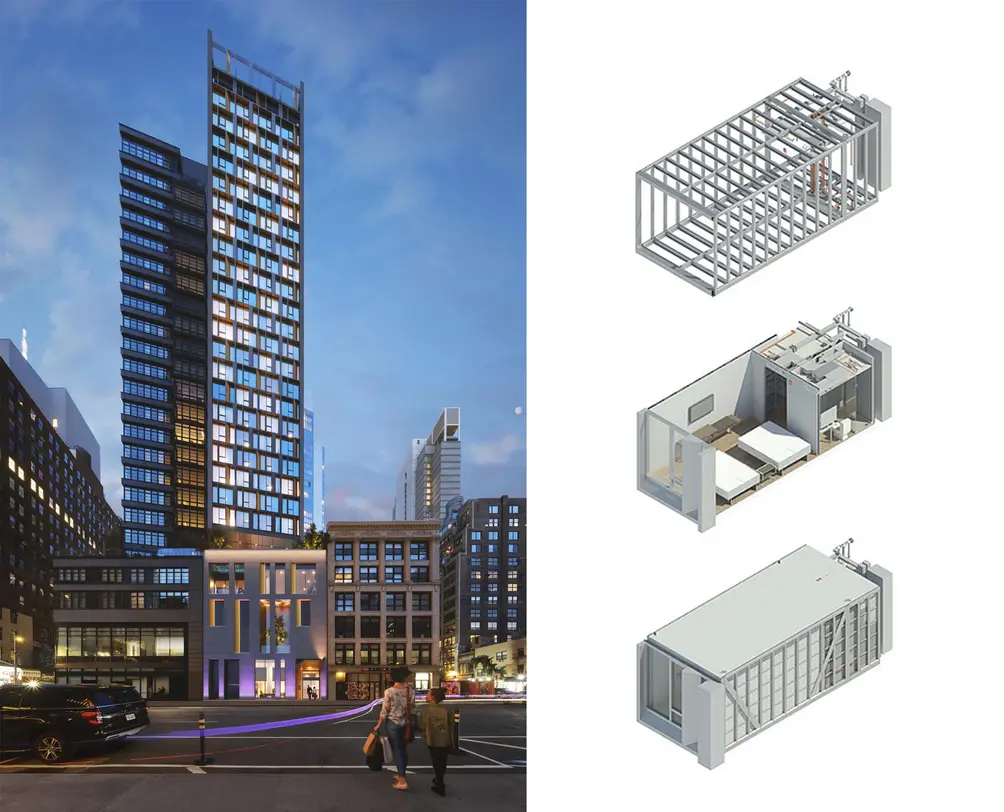 The unbuilt AC Hotel NoMad at 842 Sixth Avenue was to use modular construction. (Credit: Danny Forster & Architecture | https://www.dannyforster.com/architecture/nomad-modular-hotel)
Enhanced modular construction: When most people think of modular homes, they imagine tiny houses delivered to a property upstate, but modular construction also has a place in the urban market. For example, in 2016, Carmel Place by nArchitects delivered a 55-unit affordable residential building using modular construction. AI-assisted prefabrication could make modular projects more affordable and help deliver desperately needed housing to the city at a faster pace with fewer disruptions to neighboring buildings.
AI is already transforming real estate transactions and the day-to-day experience of living in NYC buildings. From personalized searches and niche appraisals to smarter property management, AI systems hold great promise. Better yet, if the real estate industry and city officials can leverage AI effectively, there is hope that the process of finding and approving new housing developments and even building units may accelerate.
Related Articles

Get To Know
Swim with a View: 30 Manhattan buildings with high-floor swimming pools and fitness centers
Saturday, June 20, 2026
Future New York
Above the Crowd: NYC apartments with skyline views as observation deck boom reaches new heights
Wednesday, June 10, 2026
Future New York
Which exposure is right for you + Open houses with abundant natural light
Saturday, May 2, 2026
Get To Know
What to know about Legionnaires' disease and NYC's cooling towers
Friday, July 24, 2026
Get To Know
Selling a home in NYC? Everything you need to know about capital gains taxes
Wednesday, July 22, 2026
Future New York
NYC apartments with on-site parking from $350K as new Empire Bins to claim curb space
Tuesday, July 21, 2026
Get To Know
Steals & Deals from $345K: Listings with "Motivated Sellers" or "Priced to Sell"
Friday, July 17, 2026
Get To Know
Could free childcare make New York more family-friendly again? + New affordable housing lottos with family-sized units
Thursday, July 16, 2026
Contributing Writer
Cait Etherington
Cait Etherington has over twenty years of experience working as a journalist and communications consultant. Her articles and reviews have been published in newspapers and magazines across the United States and internationally. An experienced financial writer, Cait is committed to exposing the human side of stories about contemporary business, banking and workplace relations. She also enjoys writing about trends, lifestyles and real estate in New York City where she lives with her family in a cozy apartment on the twentieth floor of a Manhattan high rise.

 6sqft delivers the latest on real estate, architecture, and design, straight from New York City.
