- Apartments
- Overview & Photos
- Maps
- Building Specialists
- Floorplans
- Sales Data & Comps
- Similar Buildings
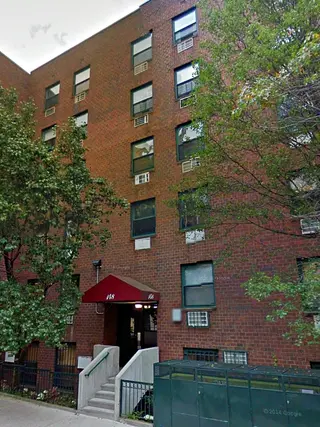
West Village Houses is a 42-building low-rise complex in Manhattan's Far West Village, completed in 1974 and converted to co-ops in 2006. Originally designed with Jane Jacobs' input and built under the Mitchell-Lama program, the complex's location has become highly desirable due to nearby developments.

West Village Houses is a cooperative complex consisting of 42 low-rise buildings located between Bank and Morton Streets and Washington and West Streets in the Far West Village. Originally designed by Perkins & Will and completed in 1974, the complex underwent a cooperative conversion in 2006. The development was significantly influenced by urbanist Jane Jacobs in the 1960s, who advocated for a community-oriented design that preserved the character of Greenwich Village. The buildings, characterized by their plain brown façades and fire escapes, have transformed from being considered the 'ugly duckling' of the area to one of the most desirable locations in New York City, thanks in part to the nearby Hudson River Park and recent neighborhood redevelopment.
Residents of West Village Houses enjoy a variety of amenities, including large apartments with features such as wide plank oak hardwood floors, in-unit washers and dryers, and central air conditioning. The complex also boasts private keyed green spaces, on-site management, and live-in superintendents. Subletting is permitted after two years of ownership, allowing for flexibility in residency. The co-op is pet-friendly and supports various purchasing arrangements, including guarantors and co-purchasers.
Notable apartments within the complex include spacious two-bedroom layouts with generous closet space and the potential for renovations to suit individual tastes. Many units offer views of the co-op's private gardens, enhancing the tranquil living experience. The location is ideal for those seeking proximity to cultural landmarks, with easy access to public transportation, including the 1, A, C, E, and L trains, as well as nearby CitiBike stations.
West Village Houses has a rich history and a strong community ethos, making it a unique residential option in Manhattan. The cooperative's commitment to maintaining a quality living environment is evident in its well-kept grounds and the active involvement of its residents in preserving the neighborhood's charm.
 West Village Houses
West Village Houses
West Village Houses
View school info, local attractions, transportation options & more.
Experience amazing 3D aerial maps and fly throughs.
For some co-ops, instead of price per square foot, we use an estimate of the number of rooms for each sold apartment to chart price changes over time. This is because many co-op listings do not include square footage information, and this makes it challenging to calculate accurate square-foot averages.
By displaying the price per estimated room count, we are able to provide a more reliable and consistent metric for comparing sales in the building. While we hope that this gives you a clearer sense of price trends in the building, all data should be independently verified. All data provided are only estimates and should not be used to make any purchase or sale decision.

 6sqft delivers the latest on real estate, architecture, and design, straight from New York City.
Like us on Facebook to keep up with the trends and
6sqft delivers the latest on real estate, architecture, and design, straight from New York City.
Like us on Facebook to keep up with the trends and 