
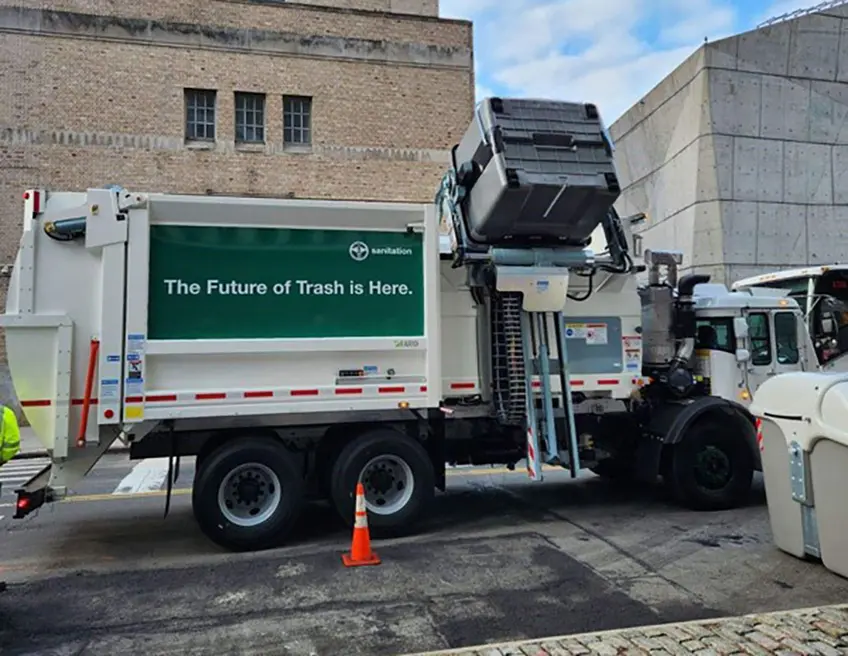
Former Mayor Eric Adams brought the so-called “Trash Revolution” to New York City, which meant changes for many owners and renters in handling waste at their building. Bins started appearing for street pickup — what Adams called the “containerization” of New York City — and separating your food and yard waste for compost collection became mandatory.
The Department of Sanitation (DSNY) reports all kinds of progress since efforts began in 2022. 70 percent of New York trash is now required to be in containers; DSNY has collected millions of pounds of food and yard waste through its compost program; and rat sightings reported to 311 declined for 12 straight months.
These efforts will continue under Mayor Mamdani, including containerization for larger residential buildings. Still, there is room for improvement when it comes to the city’s residential waste management.
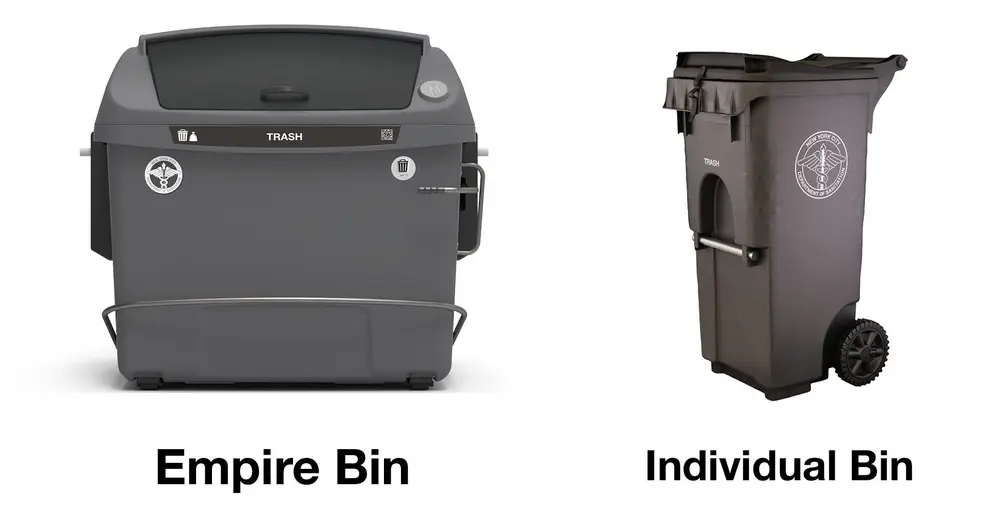 (l-r) Empire Bin for buildings with 31+ units; individual bin for buildings with >30 units (DSNY)
Empire Bins are coming for Brooklyn
That 70 percent of containerized trash includes commercial trash, food waste, and trash from one- to nine-unit residential buildings. Now the requirement is coming for larger residential buildings. A DNSY rep says: “We are aggressively going after the remaining 30 percent, with first-in-North-America stationary on-street containers and automated side-loading trucks throughout West Harlem, coming soon to parts of Brooklyn, and then the rest of the city.”
Last year, residential buildings in West Harlem were the first to get Empire Bins, the European-style, on-street containers. (Empire Bins, designed in Spain, are serviced by a $500,000 side-loading garbage truck developed in Italy, Long Island and Brooklyn.) In June 2025, former Mayor Adams announced that 100 percent of trash in that West Harlem district was covered by containerization requirements.
This year, Empire Bins are coming for residential buildings in Downtown Brooklyn, Boerum Hill, Brooklyn Heights, Fulton Ferry, DUMBO, Vinegar Hill, Fort Greene, Clinton Hill and Brooklyn Navy Yard.
There is still no concrete timeline for a full rollout of Empire Bins across the city. If it happens, any residential property with 31+ units will be required to use Empire Bins for trash. Properties with 10-30 units will be given a choice between Empire Bins or individual bins.
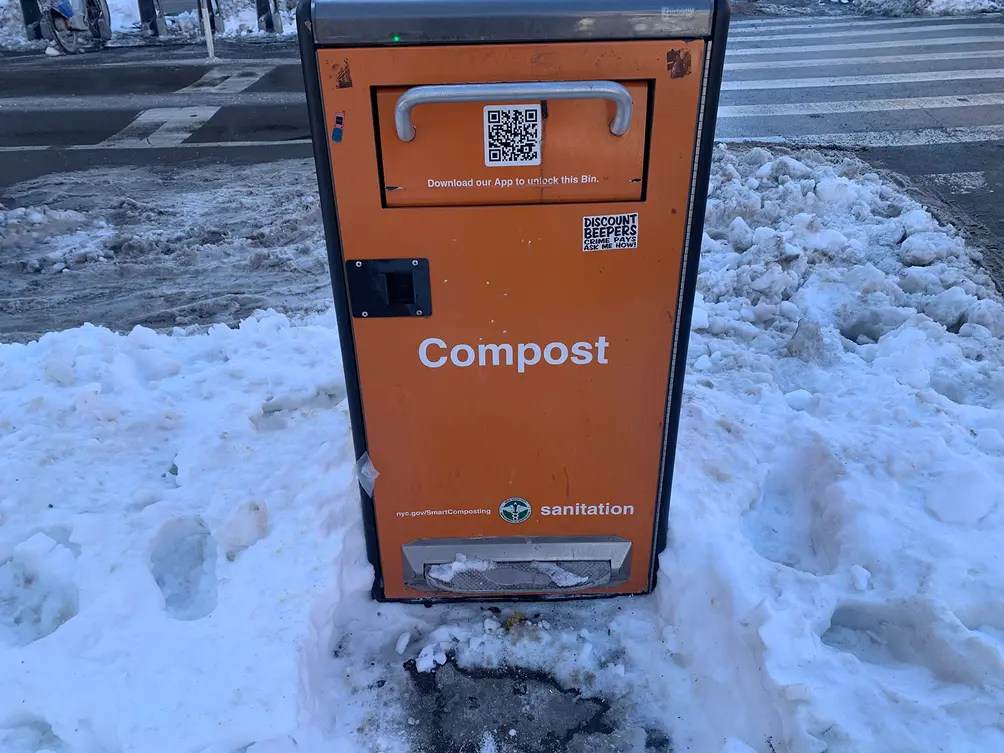 Smart compost bin (CityRealty)
Curbside organics collection continues, fines will return
New York’s 2023 Zero Waste Act required the rollout of citywide curbside organics collection for residential buildings by fall 2024. Since then, DSNY has picked up millions of tons of food and yard waste each week, even setting records this past fall.
In spring 2025, the city suspended composting fines for buildings under 30 units, just two weeks after enforcement began. (Larger buildings with more than four warnings from DSNY still get $100 fines.) Fines will resume for all buildings this year, DSNY confirmed, which should result in even wider implementation. Disposing of food and yard waste in brown compost bins remains mandatory for all residential buildings, stresses Clare Miflin, an architect and executive director of the Center For Zero Waste Design.
If your building does not offer the service, call 311 to report it. You can also look up the nearest food scrap drop-off site, which includes Smart Compost Bins that are available for drop-offs 24/7.
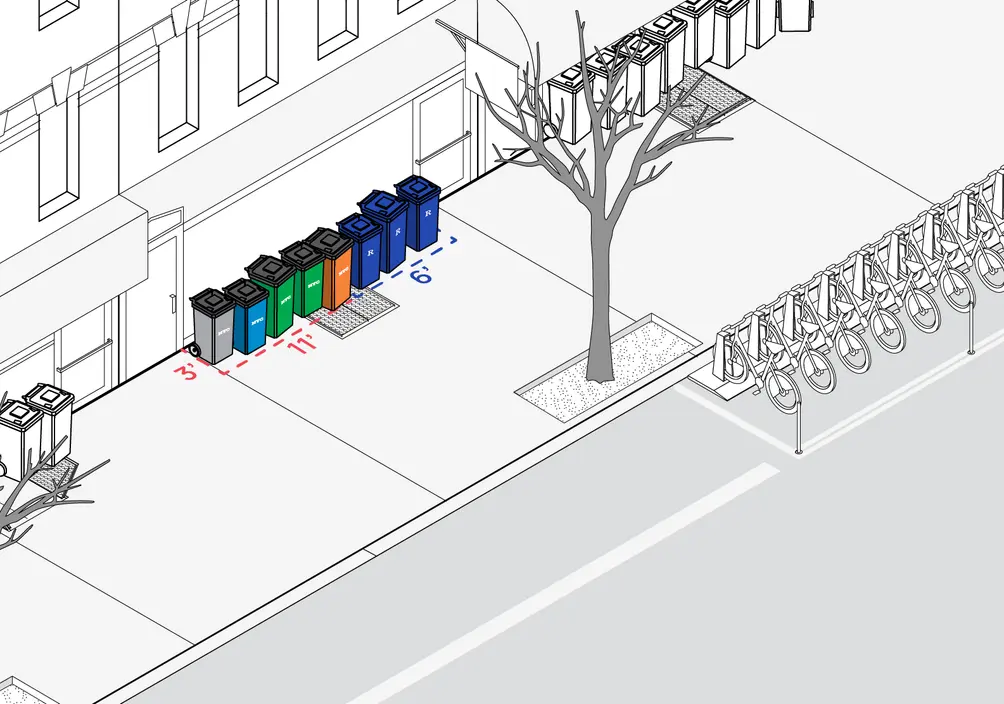 Containerization recommendations by Center for Zero Waste Design
There’s room for improvement for NYC’s residential waste
Miflin, who served on Mamdani’s transition team, says the new administration can do even more to help residential building owners transition toward containerization and seamless curbside organics collection. She notes that Adams cut funding for waste training programs for building supers and management. She believes larger buildings need more education, support and resources when it comes to using Empire Bins and collecting food and yard scraps on a large scale.
The Center for Zero Waste Design also believes the current approach to waste containerization is limited in scope and impact. The center proposed strategies on more nuanced approaches, depending on building size and use type. They’ve also developed design strategies for how bins can best work with the NYC streetscape. Similar to the push to redesign scaffolding and “Get Sheds Down,” the center proposes smarter bin use so they aren’t crowding sidewalks and inconveniencing New Yorkers
 Chestnut Commons (MHANY Management)
Miflin also pointed to the Brooklyn building Chestnut Commons as an example of new construction forging a path for waste reduction. The Passive House development features onsite composting which generates fertilizer for local gardens. She adds that incentives or fines, similar to what was enacted with Local Law 97, could push developers to add features like on-site composting, or better collection systems for trash, recycling and food scraps.
“I’m hopeful that this administration will take a great approach to waste,” she says of the future. “It should be about giving resources, trying things, seeing what works, training, and showing people how this can be done in a positive way.”
Related Articles

Get To Know
Roommates, peepholes, and pet loopholes: NYC housing rules you didn’t know existed
Thursday, August 20, 2026
Get To Know
Open Houses: Two-plus bedrooms in Manhattan's top-ranked public school districts
Thursday, August 20, 2026
Get To Know
Gallery Gossip Girl: NYC asks, “What is art,” anyway?
Thursday, August 20, 2026
Get To Know
Opposition to Local Law 97 heats up as older buildings brace for financial fallout
Wednesday, August 19, 2026
Get To Know
Should you buy first or sell first? + Below-market NYC homes from $299K
Tuesday, August 18, 2026
Get To Know
Five reasons to buy a garden home in NYC + Listings with backyards include home where FDR married Eleanor Roosevelt
Saturday, August 15, 2026
Get To Know
The risks and benefits of buying in an NYC building currently undergoing façade repairs
Thursday, August 13, 2026
Get To Know
Triple-mint NYC apartments with ensuite five-fixture baths; Sorin launches sales near Hudson Yards
Tuesday, August 11, 2026
Contributing Writer
Emily Nonko
Emily is a Brooklyn-based writer who has covered New York City real estate, architecture and design for Brownstoner, The Wall Street Journal, Dwell and other publications. You can follow her on Twitter @EmilyNonko.

 6sqft delivers the latest on real estate, architecture, and design, straight from New York City.
