
The cantilevered design of the 24-story residential condominium building planned for 23 East 22nd Street designed by the Office of Metropolitan Architecfture, which is headed by Rem Koolhaas, will have larger ceilings at its base and top and many of its lower cantilevered floors will have "floor windows."
The building is being developed by Slazer Enterprises of New City, New York, which is also developing the very slim tower at 22 West 23rd Street at the foot of Madison Avenue on the same block. That tower, which is known now as One Madison Park. has been designed by Cetra/Ruddy and has "pop-out" elements of four to six stories, slightly reminiscent of the published design a few years ago by Salvatore Calatrava of a very tall residential tower at 80 South Street with many four-story townhouses-in-the-air.
One Madison Park is under construction now and will have 90 apartments in a blue-and-light-gray glass facade with 7 "pop-out" elements of four to six stories each on its north side. The "pop-outs" appear to wrap around the building's northeast corner and do not extend to its northwest corner and, furthermore, are separated vertically by one story.
One Madison Park, which was originally called Saya, has been designed by Cetra/Ruddy Inc., and will be about 600 feet high and the tallest on the south side of Madison Square Park.
OMA, which is based in Rotterdam, the Netherlands, has designed the spectacular Seattle Public Library, the Prada Epicenter in Los Angeles and New York, the IIT Campus Centre in Chicago, and is now designing an extension of Cornell University (NY), 111 First Street, a high rise residential building and hotel in Jersey City (NJ).
Its office in Beijing is designing the monumental China Central Television Headquarters and Television Cultural Center now under construction in Beijing and the new Shenzhen Stock Exchange and a high-end residential tower in Singapore.
Its other projects include a new head office of the Rothschild Bank in London, the Cordoba Congress Center in Spain and a contemporary art museum in Riga and various projects in the Middle East.
The new, smaller building is being built in collaboration with Creative Artists Agency and will feature screening facilities. It will be 355 feet high and will cantilever about 30 feet over its neighbor to the east. The lower structure has been described as the "peek-a-boo" building as it will also offer views up Madison Avenue from many of its apartments. It has a very unusual form that staggers in two directions.
The buildings will share residential entrances at 23 West 22nd Street although the towers will be separate. The new building will have about 18 residential condominiums and is scheduled for completion in 2010. As the building steps out to the east and then back from the west, the area of every other floor differs.
According to the OMA website, "23 East 22nd Street is supported by a structural facade: a set of shear walls with openings for light and air that has been developed in collaboration with structural engineers WSP Cantor Seinuk. In areas under greatest stress, the window spacing is modified to provide increased structural area and rigidity, supporting the building like a structural corset."
The rendering at the left is by Luxigon.
The building is being developed by Slazer Enterprises of New City, New York, which is also developing the very slim tower at 22 West 23rd Street at the foot of Madison Avenue on the same block. That tower, which is known now as One Madison Park. has been designed by Cetra/Ruddy and has "pop-out" elements of four to six stories, slightly reminiscent of the published design a few years ago by Salvatore Calatrava of a very tall residential tower at 80 South Street with many four-story townhouses-in-the-air.
One Madison Park is under construction now and will have 90 apartments in a blue-and-light-gray glass facade with 7 "pop-out" elements of four to six stories each on its north side. The "pop-outs" appear to wrap around the building's northeast corner and do not extend to its northwest corner and, furthermore, are separated vertically by one story.
One Madison Park, which was originally called Saya, has been designed by Cetra/Ruddy Inc., and will be about 600 feet high and the tallest on the south side of Madison Square Park.
OMA, which is based in Rotterdam, the Netherlands, has designed the spectacular Seattle Public Library, the Prada Epicenter in Los Angeles and New York, the IIT Campus Centre in Chicago, and is now designing an extension of Cornell University (NY), 111 First Street, a high rise residential building and hotel in Jersey City (NJ).
Its office in Beijing is designing the monumental China Central Television Headquarters and Television Cultural Center now under construction in Beijing and the new Shenzhen Stock Exchange and a high-end residential tower in Singapore.
Its other projects include a new head office of the Rothschild Bank in London, the Cordoba Congress Center in Spain and a contemporary art museum in Riga and various projects in the Middle East.
The new, smaller building is being built in collaboration with Creative Artists Agency and will feature screening facilities. It will be 355 feet high and will cantilever about 30 feet over its neighbor to the east. The lower structure has been described as the "peek-a-boo" building as it will also offer views up Madison Avenue from many of its apartments. It has a very unusual form that staggers in two directions.
The buildings will share residential entrances at 23 West 22nd Street although the towers will be separate. The new building will have about 18 residential condominiums and is scheduled for completion in 2010. As the building steps out to the east and then back from the west, the area of every other floor differs.
According to the OMA website, "23 East 22nd Street is supported by a structural facade: a set of shear walls with openings for light and air that has been developed in collaboration with structural engineers WSP Cantor Seinuk. In areas under greatest stress, the window spacing is modified to provide increased structural area and rigidity, supporting the building like a structural corset."
The rendering at the left is by Luxigon.
Related Articles
Future New York
Top 10 condos in Turtle Bay and Beekman-Sutton Place + New developments and price-reduced listings
Today, June 11, 2026
Future New York
Over $600M in Manhattan contracts include FiDi penthouse with indoor slide and Mish Fine Jewelry founder’s Village co-op
Wednesday, June 10, 2026
Riverside Dr./West End Ave.
Three Waterline Square launches lottery for UWS apartments priced from $782/month
Wednesday, June 10, 2026
Future New York
Above the Crowd: NYC apartments with skyline views as observation deck boom reaches new heights
Wednesday, June 10, 2026
Future New York
Tower Residences at 50 West 66th Street lead Manhattan sales; West Chelsea co-op trades at 163% profit
Wednesday, June 10, 2026
Future New York
Inside Mayor Mamdani's "Block by Block" housing plan + 12 forthcoming new developments
Friday, June 5, 2026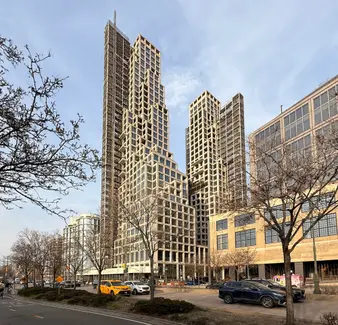
Future New York
NYC's top 10 limestone buildings that exemplify architectural excellence + New developments continuing the tradition
Friday, June 5, 2026
Get To Know
Seven tips for getting past NYC's toughest co-op boards + Prewar gems with open houses
Friday, June 5, 2026
Architecture Critic
Carter Horsley
Since 1997, Carter B. Horsley has been the editorial director of CityRealty. He began his journalistic career at The New York Times in 1961 where he spent 26 years as a reporter specializing in real estate & architectural news. In 1987, he became the architecture critic and real estate editor of The New York Post.

 6sqft delivers the latest on real estate, architecture, and design, straight from New York City.
