

At the beginning of October 2025, an incinerator shaft collapse at Mitchel Houses, a New York City Housing Authority (NYCHA) complex in the South Bronx, led to a partial building collapse. No injuries were reported, but Con Edison turned off the gas at the building and residents of apartments next to the collapsed section were displaced. Residents of neighboring buildings told Gothamist that they'd smelled gas for months before the collapse. NYCHA distributed hot plates to households that would not be able to use their stoves or ovens without gas, but residents without hot water were looking into other places to stay.
The disaster was emblematic of aging NYCHA buildings, disinvestment in public housing by federal and state governments, and mismanagement at the local level. One alternative is New York City's Permanent Affordability Commitment Together (PACT) program that allows NYCHA to contract with private developers to rehabilitate public housing under the federal Section 8 program. A case in point may be found at NYCHA's Fulton and Elliott-Chelsea Houses in West Chelsea, where a partnership between NYCHA, Related Companies, and Essence Development calls for demolishing the existing campuses and replacing them with soaring new mixed-income buildings.
In this article:

Enlarge Image
Enlarge Image
Enlarge Image
Enlarge Image
Enlarge Image
Enlarge Image
In June 2025, permits were filed to demolish Chelsea Addition, a 14-story, 94-unit building at 441 West 26th Street that also houses the Hudson Guild Theater ("Hudson Guild") offices and childcare services. More recently, permits were filed for a new 40-story tower to rise in its place. Ismael Leyva Architects is the architect of record, and the permits call for a total of 481 housing units to start on top of a community facility, presumably new offices for Hudson Guild. Another new tower is set to rise next to it in the next phase of construction, and the buildings' ten-story wings will frame a common courtyard.
The units in the new building effectively replace the apartments in the buildings that are to be demolished in the first phase of construction. In addition to Chelsea Addition, the buildings at 420 West 26th Street, 415 West 25th Street, 288 Tenth Avenue, and 450 West 27th Street are set to be demolished. Residents received notices that they would have to move out within three months in late July 2025 (h/t City Limits).
The team is presumably trying to do as much as they can before the mayoral election on November 4, when it remains to be seen how the project could proceed under a new administration. Zohran Mamdani's housing plan includes doubling the City’s capital investment in major renovations of NYCHA housing. Andrew Cuomo proposes a dual-pronged plan to restore NYCHA that includes expanded use of PACT. Curtis Sliwa's housing plan does not mention NYCHA by name, but calls for shifting away from corporate developers.
Redevelopment plans for Fulton and Elliott-Chelsea Houses have been in the works since before the pandemic; and in June 2023, the partnership between NYCHA and the developers called for demolishing the existing campuses and replacing them with towering new mixed-income buildings that would include both replacements for over 2,000 existing NYCHA units and 875 new affordable units. As the cost to repair the existing buildings was higher than initially believed, NYCHA's board approved a plan to demolish and replace them in 2024.
Enlarge Image
Enlarge Image
Enlarge Image
Enlarge Image
Enlarge Image
The new project is to offer energy-efficient infrastructure, new apartments with custom-designed finishes and in-unit laundry, and state-of-the-art amenities. It is also set to offer community improvements like a new healthcare facility, a new grocery store, expanded childcare offerings, and new landscaped outdoor space. Residents of the buildings under construction will be relocated to vacant units at other buildings in the complex during demolition and construction, and moved back once the new, modernized towers are complete, approximately four years later.
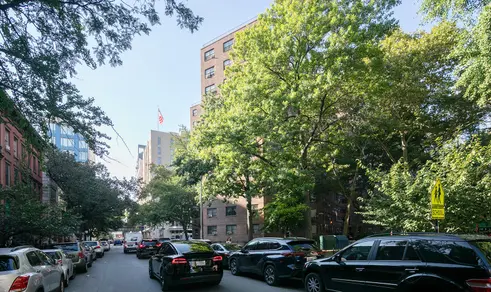 West 25th Street before
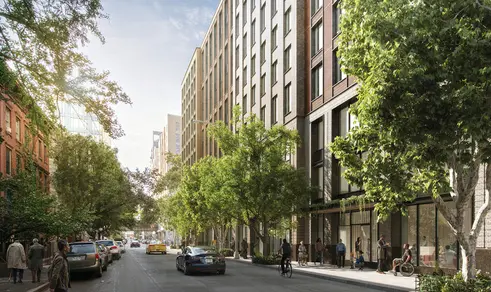 West 25th Street after
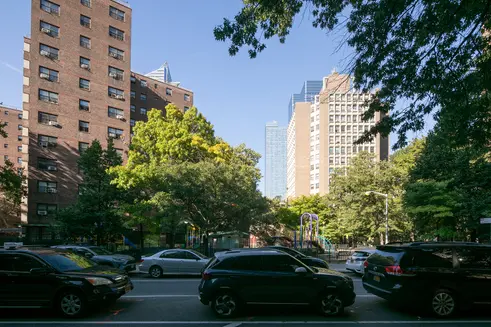 Courtyard before
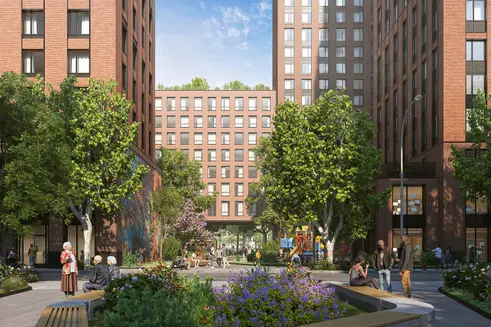 New courtyard
 Current conditions
 New terrace
A Bridge Plan promises immediate resources as well as improvements while the new buildings are underway. NYCHA is legally required to replace each unit "one-for-one," and displaced residents will retain their right to return. And as per the terms of PACT, all tenants' rights and rents will be preserved.
But not everyone is assuaged. Grassroots groups are protesting the new buildings, and The Daily News calls it "a cynical erasure of public process — and a warning shot for every public housing community in New York City." It should be noted that not all of the opposition is coming from Fulton and Elliott-Chelsea House residents; some opponents are locals who aren't eager for the construction. Incidentally, the complexes are located near some of New York City's most expensive real estate.
But not everyone is assuaged. Grassroots groups are protesting the new buildings, and The Daily News calls it "a cynical erasure of public process — and a warning shot for every public housing community in New York City." It should be noted that not all of the opposition is coming from Fulton and Elliott-Chelsea House residents; some opponents are locals who aren't eager for the construction. Incidentally, the complexes are located near some of New York City's most expensive real estate.
Sentiment is divided among the residents who will be most directly affected by the project. Some say that between issues like heat and hot water outages, elevator outages, and mold, sparkling new doorman buildings with dishwashers and washer-dryers can't come soon enough. Others are afraid of losing the communities they've cultivated in their building when they move. And still others, some of whom are senior citizens or speak little English, are confused about what's going on.
However, PACT projects are underway throughout the city without adverse effects to residents. One success story may be found at Harlem River Houses, one of the United States' first federally funded housing developments built for African Americans. Comprehensive improvements include facade repairs, sustainability upgrades, updated elevators and infrastructure, and apartments renovated with new floors, lighting, and appliances. New playgrounds were added to the central courtyard, and a historic fountain and public art were restored. The improvements have led to enhanced quality of life for residents and a 2025 Lucy G. Moses Preservation Award.
Related Articles

Future New York
Views, Light, and Value: A Q&A with Kayla Lee on what today’s NYC buyers really want
Friday, July 24, 2026
Future New York
Flurry of new condos coming to Chelsea include redevelopment of the Corlears School
Friday, July 24, 2026
Future New York
Price Cuts: Four-bed at The Dakota slashed by $3.8M; Majestic 30-foot-wide Brooklyn Heights house trimmed by $500K
Wednesday, July 22, 2026
Future New York
Greenwich Village leads nearly $700M in Manhattan sales; Tribeca penthouse tops the week at $13.25M
Wednesday, July 22, 2026
Future New York
NYC apartments with on-site parking from $350K as new Empire Bins to claim curb space
Tuesday, July 21, 2026
Future New York
Phillies pitcher's Soho penthouse leads Manhattan contracts; Hampshire House penthouse finds buyer after auction
Tuesday, July 21, 2026
Future New York
Bally’s Bronx Casino files construction permits for expansive 19-story waterfront complex
Tuesday, July 21, 2026
Future New York

 6sqft delivers the latest on real estate, architecture, and design, straight from New York City.
